
OEM furniture marketing should help an original equipment manufacturer establish production fit quickly. Can you handle the materials and processes? Support the volume profile? Work through sampling? Explain who owns each step when a drawing or schedule changes?
Your marketing should make those answers easier to find and help the right buyer prepare a useful request for quotation. Start with the work your operation wants, then connect that capability to search, technical proof and sales qualification.
CAPABILITY → TECHNICAL PROOF → RFQ
An editorial framework for organizing a buyer’s evaluation. The three stages are an editorial recommendation.
Choose the work before choosing the keywords
Review recent RFQs with sales and operations. Group them by product type, material, process, quantity profile and commercial fit. Identify the work you can support and the requests that absorb time without becoming suitable opportunities.
Precise capability and responsibility information gives buyers a useful basis for comparison. Check your own input costs, available capacity and supplier delivery commitments before promising a schedule.
Choose one capability with a clear audience. A manufacturer of a defined furniture component needs different content from a business coordinating sourcing, assembly and distribution. Make that distinction visible.
Build a capability page that answers a procurement review
For a proposed metal furniture-component page, explain the actual materials, processes, finishing options, engineering support and inspection scope. Include dimensional or tolerance information only when operations has approved the values and their conditions.
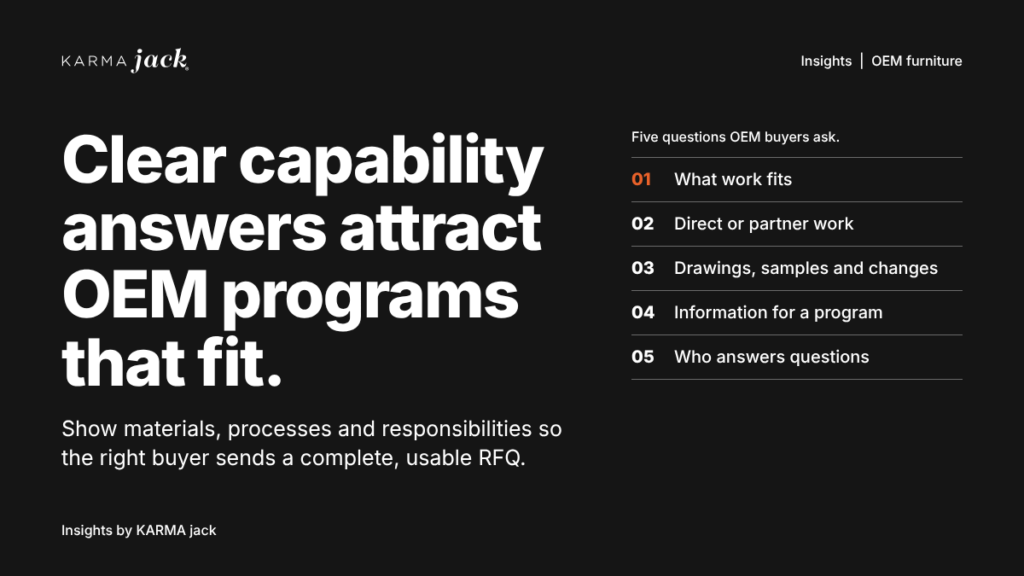
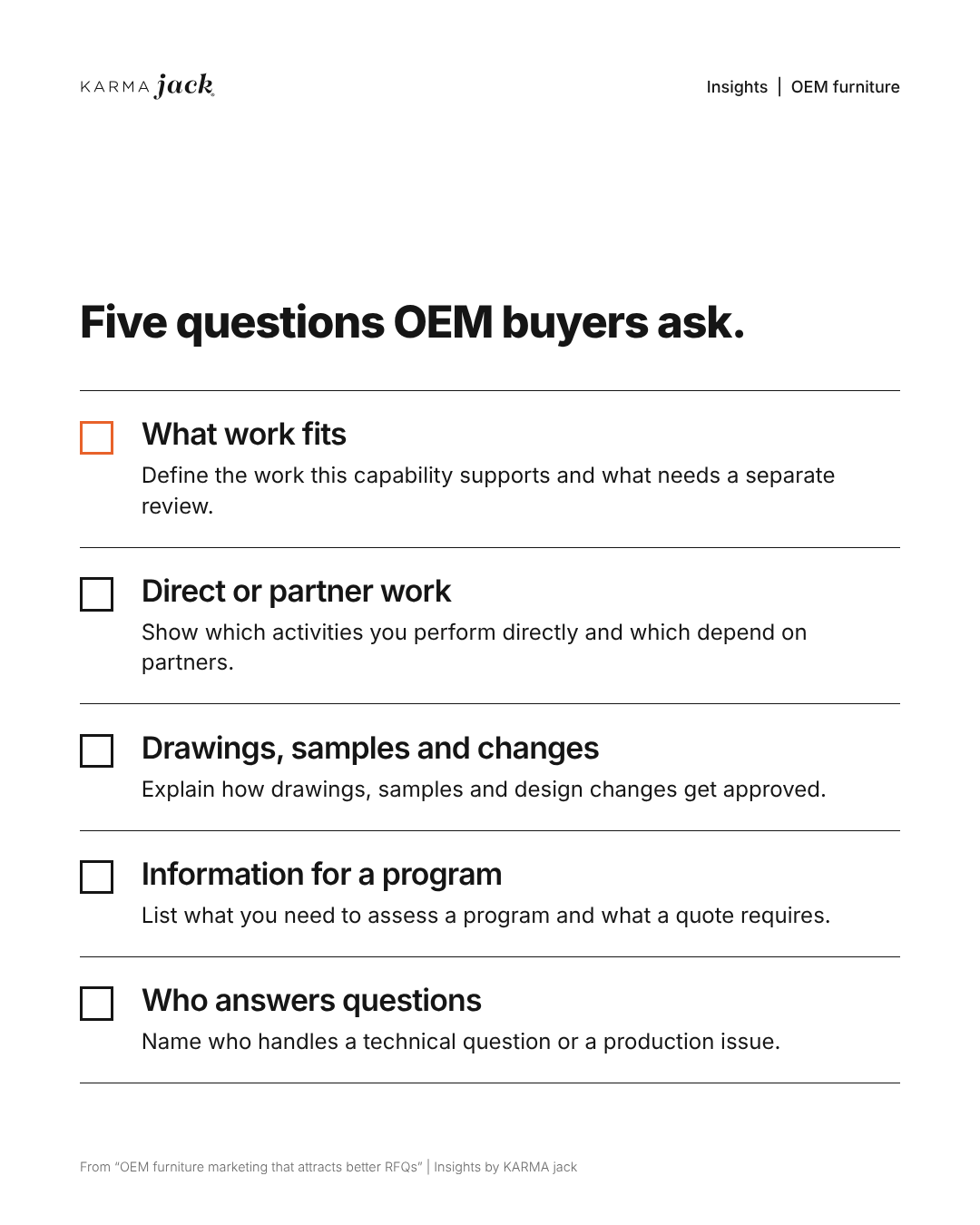
Organize the evidence around questions a buying team can use:
- What work fits this capability, and what needs a separate review?
- Which activities are performed directly, and which depend on partners?
- How are drawings, samples and changes approved?
- What information is required to assess a program?
- Who handles a technical question or a production issue?
- Use genuine, permission-cleared photographs. Label prototypes, samples and production work accurately. A caption explaining a joint, finish or assembly feature can make a photograph useful in a supplier discussion.
- Do not imply ownership of a partner’s plant or equipment. A clear account of sourcing and coordination responsibilities can be valuable on its own.
Publish the knowledge behind your RFQ checklist
A useful checklist can become an article, a landing-page resource and a sales follow-up. Explain why each requested item matters.
Explain which items are needed for an initial conversation and which are required for a quotation:
- Drawing revisions and material/finish requirements.
- Expected quantities, releases and sampling needs.
- Acceptance criteria and the responsible reviewer.
- Packaging and delivery requirements.
- Add short answers to recurring questions. For example: “What happens if the design is still changing?” Describe your verified review process and who confirms the production revision.
- Avoid copying legal terms into a marketing promise; ownership, confidentiality and commercial obligations belong in the approved agreement.
- Provide a company-approved document-transfer route for confidential drawings. Keep them out of public AI tools and ordinary marketing systems that have not been approved for that information.
Make your expertise accessible to search and AI-assisted buyers
Use one substantive page for each genuinely distinct capability or application. Connect it through descriptive links to related process information, program examples and the RFQ checklist.
Put the important facts in visible text, even when the supporting evidence also lives in a download.
An AI-assisted buyer might ask, “What should I check before choosing an OEM furniture assembly partner?” A useful answer can cover sample approval, production responsibility, packaging, change handling and the information needed for a review.
Answer from verified practice and identify where the buyer needs a project-specific discussion.
Google’s current guide says you don’t need to write in a special way for generative AI search, and there is no ideal page length. It also says Google Search does not use llms.txt (a proposed file that summarizes a site for AI tools) for visibility or ranking. [1] Prioritize accurate, distinctive technical content and a working site.
Have your web team check index eligibility, links and rendered content on the priority pages. Where structured data fits, it must describe the visible content. Do not invent a price or review to make a capability page resemble an online store.
Match promotion to a defined capability
Illustrative search themes include “contract manufacturing for metal furniture components” and “OEM furniture assembly partner.” Search volume is unmeasured. Validate the terminology against customer interviews, actual search data and language from RFQs.
For a focused paid-search test:
- Send each capability theme to its matching page.
- Review queries for consumer purchases, jobs, equipment sales and services you do not offer.
- Judge inquiries by production fit as well as cost; a cheap submission can still be unsuitable.
- Account-focused content can introduce a verified capability to a defined group of relevant manufacturers. Use approved audience data and confirm platform targeting. Give the audience a resource worth opening, such as a program-readiness checklist or an annotated production overview.
- For permitted nurture, respond to the next known requirement. Send the sampling explanation when sampling is the issue, or the packaging checklist when a buyer is defining delivery. Repeated generic “checking in” messages add little information.
Track quote quality and production fit
Carry the originating page, campaign and supplied project information into the CRM. Assign ownership for technical questions and record why an inquiry advances or stops.
Measure accepted RFQs, quotations issued, missing-information follow-up and won opportunities by capability where attribution allows. Keep early-stage interest separate from a production-ready program. Review the operational fit of wins as well as their volume.
Before estimating a percentage improvement, establish your existing inquiry and quote baselines, definitions and time periods. Changes in order mix can alter the value of a lead even when the count stays flat.
Test the RFQ path on one production program
Sales and operations should select one capability and agree what makes a program suitable. The estimator identifies the minimum brief for feasibility and the additional inputs needed for a quote. Marketing builds that distinction into the page and checklist. Test the approved drawing-transfer route and sales handoff before promotion.
Create one program record with application, source, quantity profile, material and finish needs, drawing revision, sample stage and next step. Keep follow-up submissions and revised drawings with that program. Count a new revision as part of the existing program.
Review accepted RFQs as a share of valid inquiries from the same intake period, and count how many require another request for essential information. Follow quotation and win outcomes against that original group as decisions mature. Review the production fit of wins with operations. Some orders suit your plant better than others.
If unsuitable volume profiles dominate, state program fit more clearly. If promising briefs repeatedly lack acceptance criteria, improve the checklist. If quotes stall after sampling, investigate the approval process before expanding advertising. Treat this as a proposed diagnostic for your own bottleneck. It is not an industry conversion benchmark.
OEM furniture RFQ FAQs
How should an OEM furniture supplier describe partner work?
Explain which processes the business performs directly and which depend on partners. Identify who owns drawings, samples, changes and technical questions. Do not imply ownership of a partner’s plant or equipment.
What information helps a furniture RFQ move forward?
Clarify drawing revisions, materials and finishes, quantities, release schedules, sampling, acceptance criteria, packaging and delivery. Separate what is needed for an initial discussion from what is needed for a formal quote.
Does a revised drawing count as a new marketing lead?
Keep the revision with the existing production-program record. Track the current drawing, sample stage, missing information and next step so follow-up activity does not inflate the inquiry count.
Make the next program easier to assess
KARMA jack’s manufacturing and B2B services include strategy, technical storytelling, niche search, conversion-focused web design and lead generation. [2] That combination works best when discovery starts with operational fit and measurement continues into the sales process.
Pick one capability, publish the information a buyer needs to evaluate it and connect that page to an RFQ route your team can use. Let’s talk strategy.

