
Healthcare growth with AI starts with capacity and a reliable patient handoff. Confirm which services can accept demand, choose one bounded improvement and measure completed visits, staff workload and patient experience together.
AI can support selected marketing and administrative tasks. The useful question is where it improves the patient journey without adding errors, privacy risk or hidden work for staff. Begin with a specific bottleneck and give someone responsibility for the result.
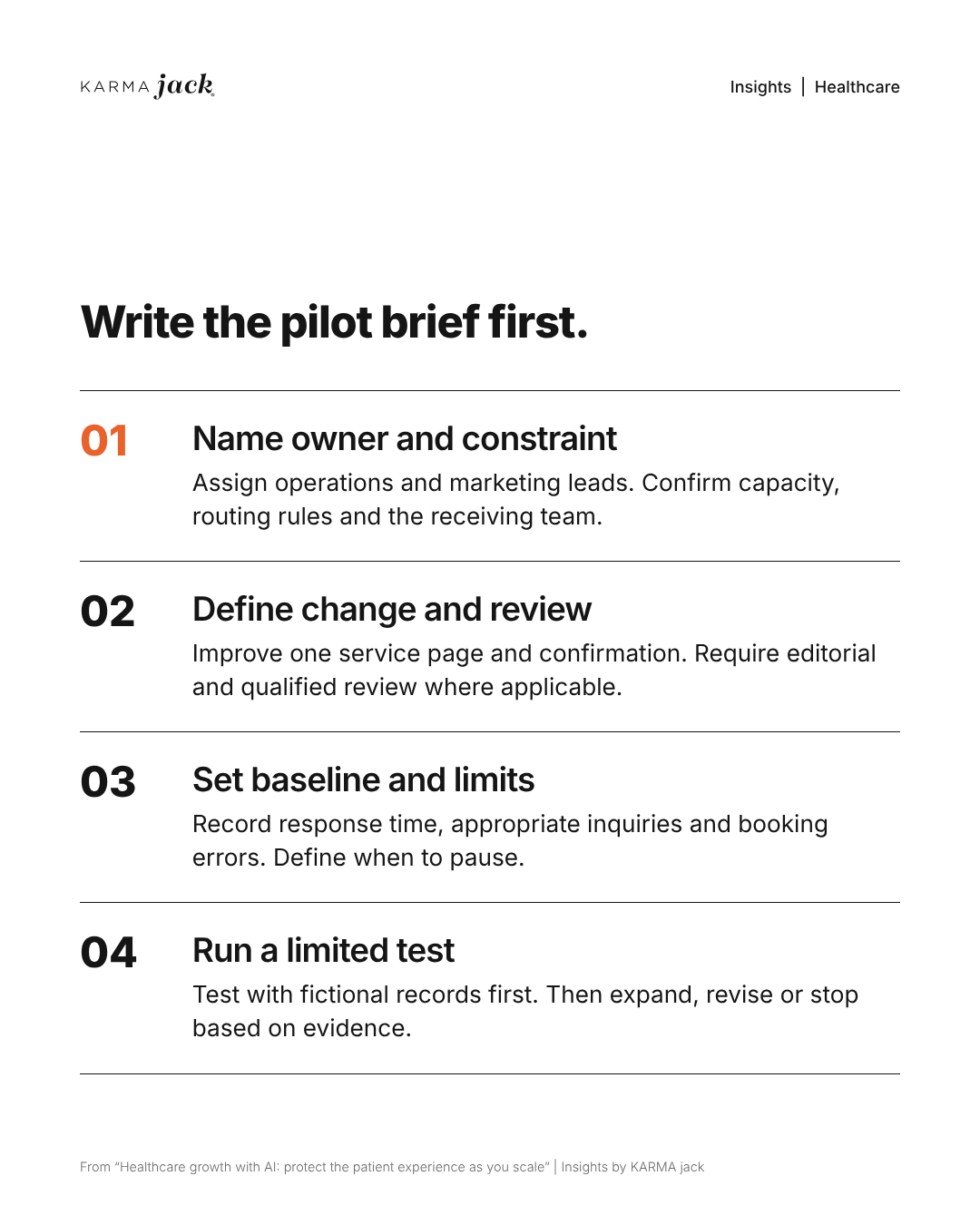
Write the pilot brief in four steps
Use this working example for one service-page and appointment-request improvement. It is a planning method, not a forecast or a clinical implementation plan.
- Name the owner and constraint: assign an operations lead and a marketing lead. Confirm the service and location with capacity, the routing rules and the staff team that will handle requests.
- Define the change and review: improve one service page and its request confirmation. If AI assists with the draft, use approved public information. Require editorial review and qualified privacy or clinical review where applicable.
- Set the baseline and failure criteria: record the current response time, appropriate inquiries and booking errors using approved measurement. Define when to pause, including lost requests, wrong confirmations or disclosure of restricted information.
- Run a limited test and decide: test with fictional records first, then use only the approved pilot scope. At the review date, compare outcomes and staff correction time with the baseline. Expand, revise or stop based on the evidence.
Put the decision, evidence, owner and next review date in one shared record. A practice with many inquiries but slow responses may need to repair the handoff before buying more traffic. A practice with spare capacity and a reliable handoff may be ready to test a focused campaign.
For an AI-assisted drafting test, record drafting time, review time, corrections and unanswered requests. Exclude patient records and identifiable feedback from the input. Check service claims and links against approved public sources, then test the page, confirmation and staff handoff on a phone.
How do you know if a practice is ready for more marketing?
Talk with operations before choosing a campaign goal. Which services have capacity? Which locations can accept appropriate new patients? What information does the scheduling team need to route an inquiry correctly? Use verified answers to shape the message and destination page.
Avoid broad promises about availability, insurance coverage or outcomes. Describe the actual next step, whether that is a consultation request, a referral review or a call with the scheduling team. Explain when a request is subject to confirmation.
Use AI for a defined piece of the work
A marketing team might use AI to turn approved public information into a first-draft outline, propose clearer headings or organize non-sensitive feedback. Each task should have a defined input, expected output and reviewer.
Compare the new process with the old one. A draft that takes less time to generate but much longer to fact-check may not save time. Count review and correction work, and record the types of mistakes the team sees.
Patient information requires a separate review. The HHS business associate guidance explains how responsibilities can extend to vendors performing functions involving PHI. Do not send records to a new tool just because the intended project is called marketing.
Keep the patient handoff connected
Build a clear path from the campaign to the service page and from that page to the appropriate staff team. Use the same service names and expectations throughout. If the campaign describes an initial consultation, the form and follow-up should explain that same step.
Test the entire path on a phone. Check forms, confirmations, missed-call handling and after-hours messages. Give people an alternative when an automated route does not fit their needs. Staff should know who owns unanswered requests.
Measure growth and experience together
Choose business measures that the team can explain and verify: appropriate inquiries, scheduled visits, completed visits and cost per completed visit where measurement is permitted and reliable. Describe attribution limits instead of presenting every appointment as a direct campaign result.
Track experience alongside those measures. Useful indicators include time to staff response, booking errors, unresolved requests and complaints. Aggregate reporting can support decisions, but aggregation alone is not a privacy review. Use an approved measurement design and keep patient information out of advertising platforms unless the proposed use has been properly reviewed and authorized.
Use a decision sheet for the next campaign
Before increasing spend, complete a decision sheet for the selected service:
- Available appointment capacity
- Accepted inquiry types
- Promised response window
- Current response time
- Person who resolves missed requests
Use the same definitions each week. Treat a request for information, a confirmed booking and a completed visit as separate events.
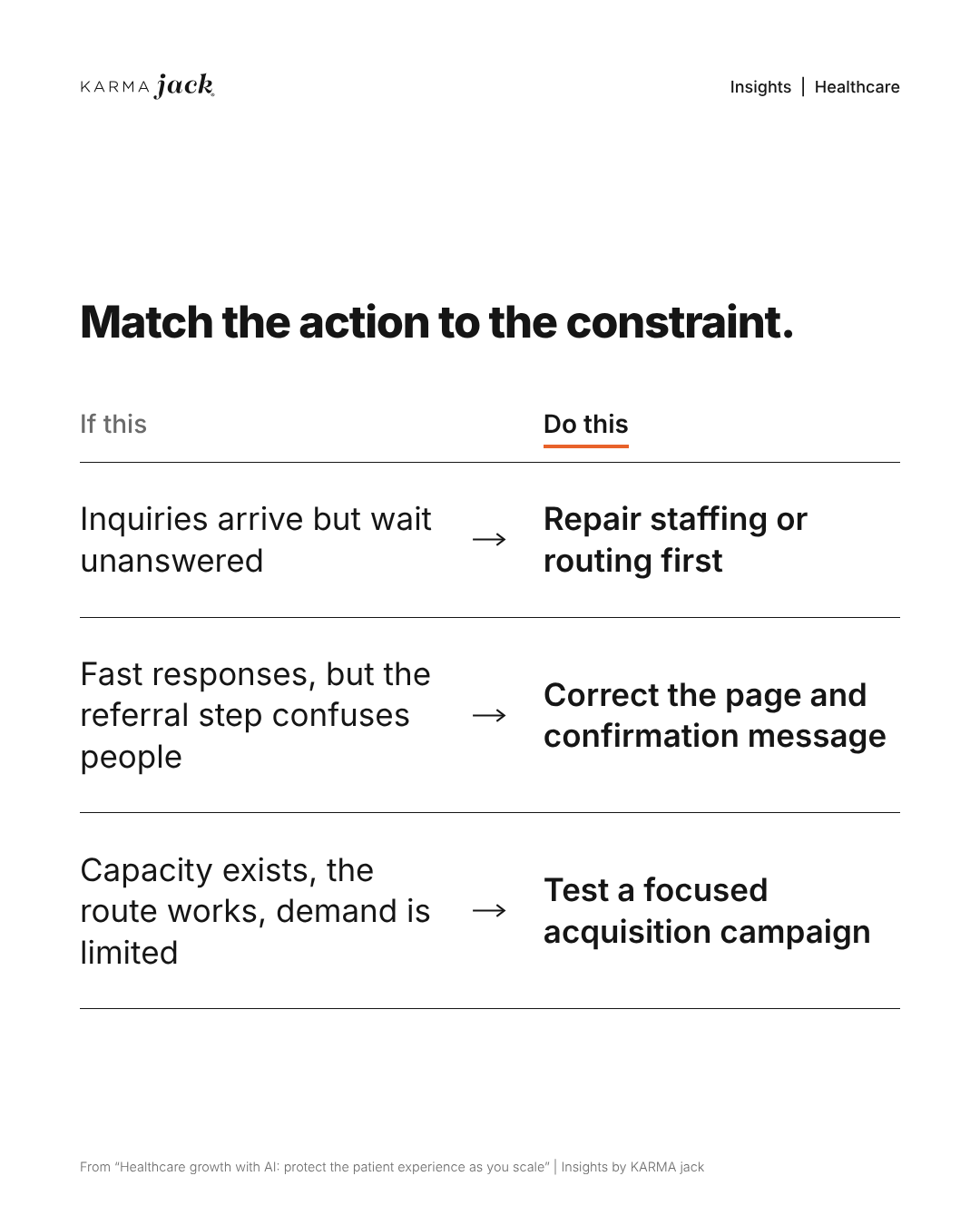
At the review, choose the action that matches the constraint. If appropriate inquiries arrive but wait unanswered, repair staffing or routing first. If the team responds promptly but people cannot understand the referral requirement, correct the page and confirmation message. If the service has capacity, the route works and demand is limited, test a focused acquisition campaign. This is a recommended decision framework, not evidence that a specific channel will produce patients.
Keep campaign cost and outcomes in approved reporting. If patient-level attribution is unavailable or inappropriate, report aggregate trends and the attribution gap. Do not force a match by sending appointment records to an advertising platform. Assign someone to check whether the chosen improvement reduced unresolved requests without increasing staff correction work.
Does AI actually save staff time?
If a pilot reduces administrative effort, decide where that capacity should go. A team might use it to return calls sooner, improve instructions or follow up on incomplete requests through approved channels. Those choices need an owner and a schedule.
Do not assume time saved in one task automatically becomes more time with patients. Ask staff whether the improvement is real, whether workload moved elsewhere and whether the revised process is sustainable.
Build a small pilot before expanding
Expand when the evidence supports it. Keep the scope limited when the results are mixed. A useful growth system can be improved gradually without promising that every new tool will transform the practice.
Common question: where should a healthcare team start with AI?
Start with a low-risk, bounded task using approved non-patient material and a named reviewer. Establish whether it improves quality or workload before extending it to more consequential processes. Keep patient care decisions with qualified professionals.
What should operations confirm before increasing a healthcare campaign budget?
Confirm service capacity, accepted inquiry types, the promised response window, actual response time and who resolves missed requests. Repair unanswered inquiries before increasing demand the team cannot handle.
How should a team judge whether AI-assisted drafting saves time?
Count drafting, fact-checking, review and correction time together. Use approved non-patient material and compare with the previous process. Faster generation alone does not establish a useful workload saving.
What if patient-level marketing attribution is unavailable or inappropriate?
Report permitted aggregate trends and the attribution gap. Do not force a match by sending appointment records to an advertising platform. Keep the measurement design subject to the appropriate review.
KARMA jack brings strategy, creative and digital marketing together. Talk with our team about connecting your growth plan to a clearer website experience.

