
Generative engine optimization, or GEO, is the work of improving how a business and its content can appear in AI-generated answers. It includes clear writing, accessible pages, accurate business information and evidence readers can check. No method can guarantee that an AI platform will mention or cite a brand.
For a business owner, the useful question is simple: when someone asks about the problem you solve, have you published something that helps them make a decision?
That is where a practical GEO strategy starts.
How GEO fits with SEO and AEO
- SEO: Search engine optimization improves a website’s ability to be discovered through search.
- AEO: Answer engine optimization emphasizes answering questions clearly.
- GEO: Generative engine optimization focuses on how information may appear in AI-generated answers.
Treat them as related ways of improving the same customer experience. A service page should explain what you do. A comparison should make the tradeoffs understandable. A research article should let a reader inspect its evidence. Creating separate, nearly identical pages for every acronym adds work without adding value.
Google’s guidance makes that overlap concrete: pages do not need a special AI schema or a new machine-readable file to appear in its AI search features. Existing SEO fundamentals still apply. [1]
What early GEO research can tell you
The research paper GEO: Generative Engine Optimization tested changes to content in a benchmark environment. Its authors reported visibility improvements of up to 40% under their experimental conditions and found that results varied across subject areas. [2]
That finding is not a forecast for your website. The paper was revised in 2024, the tested systems have changed, and benchmark visibility is different from leads or revenue. A responsible takeaway is to test useful editorial improvements rather than sell a guaranteed lift.
Relevant evidence can strengthen an article. A statistic added only to attract a citation can also distract from the question. Use data when it helps the reader understand the decision, and explain its limits.
Start with a real customer question
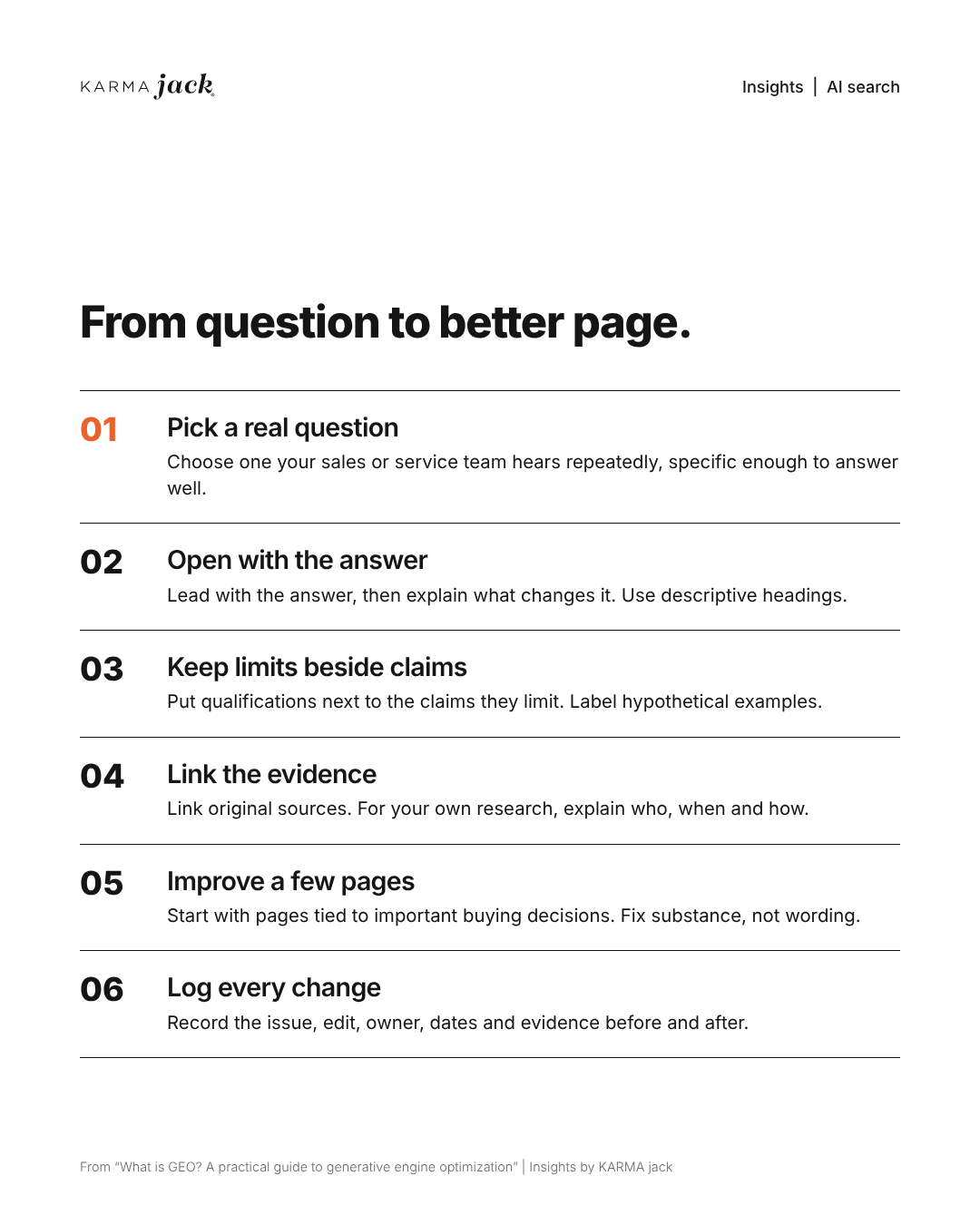
Choose a question your sales or service team hears repeatedly. Make it specific enough to answer well.
For example, a buyer researching a multi-location website may ask, “What should be different on each location page?” A useful article would explain local services, contact details, operating hours and location-specific proof. It would also explain when a new page adds little value.
Illustrative before: “Every location offers great service. Contact us.”
Illustrative after: “This location page should identify the services actually available here, the current hours, any appointment requirements and the correct contact route. Explain genuine differences from other locations.” Replace this editorial example with verified local facts before using it as customer-facing location copy.
The goal is a complete answer to a meaningful question. You do not need a long introduction about how fast technology is changing.
Build an answer someone can use
Open with the answer, then explain what changes it. Use descriptive section headings. Keep qualifications close to the claims they limit.
If cost depends on size, scope or location, say so beside the cost discussion. If your example is hypothetical, label it. If a recommendation comes from experience rather than a published study, identify it as your recommendation.
Link to the original source for an external factual claim. For your own research, explain who was included, when the work happened and how the result was calculated. Readers should not have to guess whether a number describes five customers or an entire industry.
These are editorial standards we recommend because they make content easier to evaluate. They are not a disclosed formula for AI source selection.
Improve a small group of pages first
Pick a few pages connected to important buying decisions. Record their current organic performance, the questions they answer and the actions visitors can take. Then improve the substance: missing explanations, outdated details, weak examples and confusing next steps.
Keep a change log for a small set of pages. Use these fields so the next reviewer can repeat the work:
- Page and question: Page URL and customer question the page should answer.
- Issue and edit: Issue found, supporting source and proposed edit.
- Owner and dates: Owner, change date and review date.
- Evidence: Evidence before and after: customer feedback, qualified inquiries and any tracking gaps.
- AI answer test: If testing AI answers: exact question, platform, date, location context, cited URL and whether the answer is accurate. Count citations separately from brand mentions.
Treat a change after an edit as an observation. Check seasonality, promotion and other changes before assigning a cause.
A stronger answer is worth publishing even when an AI platform does not cite it. Your website still needs to help the person who lands on it.
Common questions about GEO
Does GEO replace SEO?
No. Technical access, useful content and a coherent website remain important. GEO adds attention to how information may be represented in generative answers.
Can a business guarantee an AI recommendation?
No. A business controls its own content and publishing practices, not the response an AI platform produces for a particular person.
Does the GEO study predict a 40% improvement for my website?
No. The study reported up to 40% visibility improvement under its experimental benchmark conditions, with results varying by subject. The paper was revised in 2024. Benchmark visibility is not a forecast of traffic, qualified leads or revenue.
Where should qualifications and limitations appear?
Keep them beside the claim they limit. A reader should see the relevant date, geography, population, scope or cost condition without having to hunt through a distant footnote.
What belongs in the first GEO change log?
Record the page URL, customer question, issue, supporting evidence, edit, owner and review date. Track qualified inquiries separately from sampled AI mentions or citations, and record gaps in measurement.
Give your best answers a better home
Start with one question that matters to your customers. Answer it clearly, support the claims and give the reader a useful next step. Then build that standard into the rest of your content.
KARMA jack’s technical, local and on-page SEO services can support that work. Bring a small set of customer questions and the pages meant to answer them, then decide which content or access problem to address first. [3]
Sources
[1] Google Search Central: AI features and your website
