
AI visibility monitoring tracks how a brand appears in a defined set of AI-generated answers, whether those answers are accurate and what measurable activity follows. A useful report separates brand mentions, links to your website, referral visits and business outcomes.
Those are four different things. Combining them into one score can make a report look simple while hiding the information a business needs to act.
Start with a modest, repeatable process. Be explicit about what the data can and cannot tell you.
Your first useful report
Start with one service, one audience and the questions your sales team already hears. Keep the first review small enough to repeat.
- Choose a customer decision: for an HVAC company, whether a homeowner can find the right repair service in an area it actually serves; for a manufacturer, whether a buyer can find the right application and request a technical conversation.
- Record the answer and the source behind it. If an answer lists the wrong service area, fix the underlying website or profile through your normal approval process before testing again.
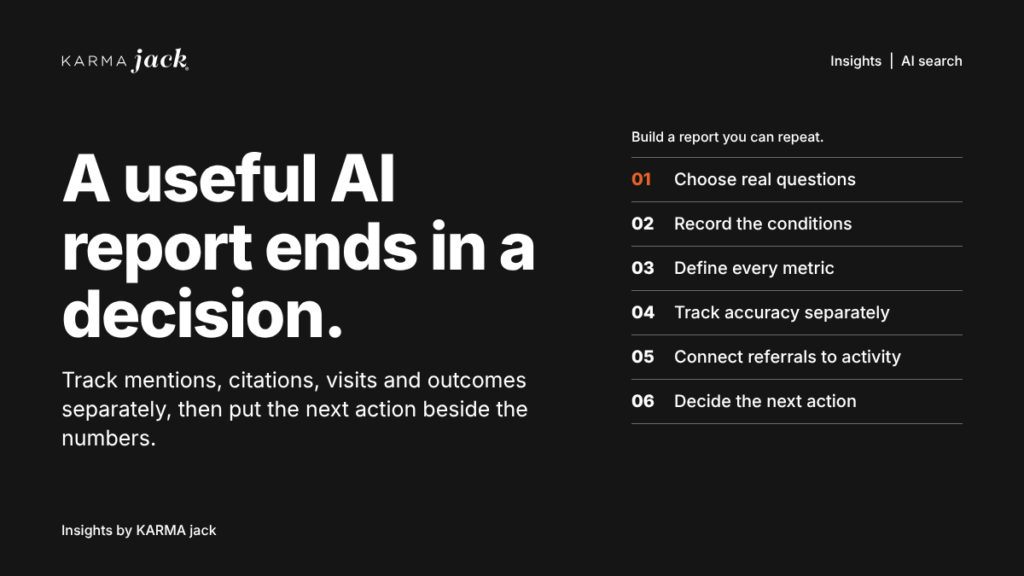
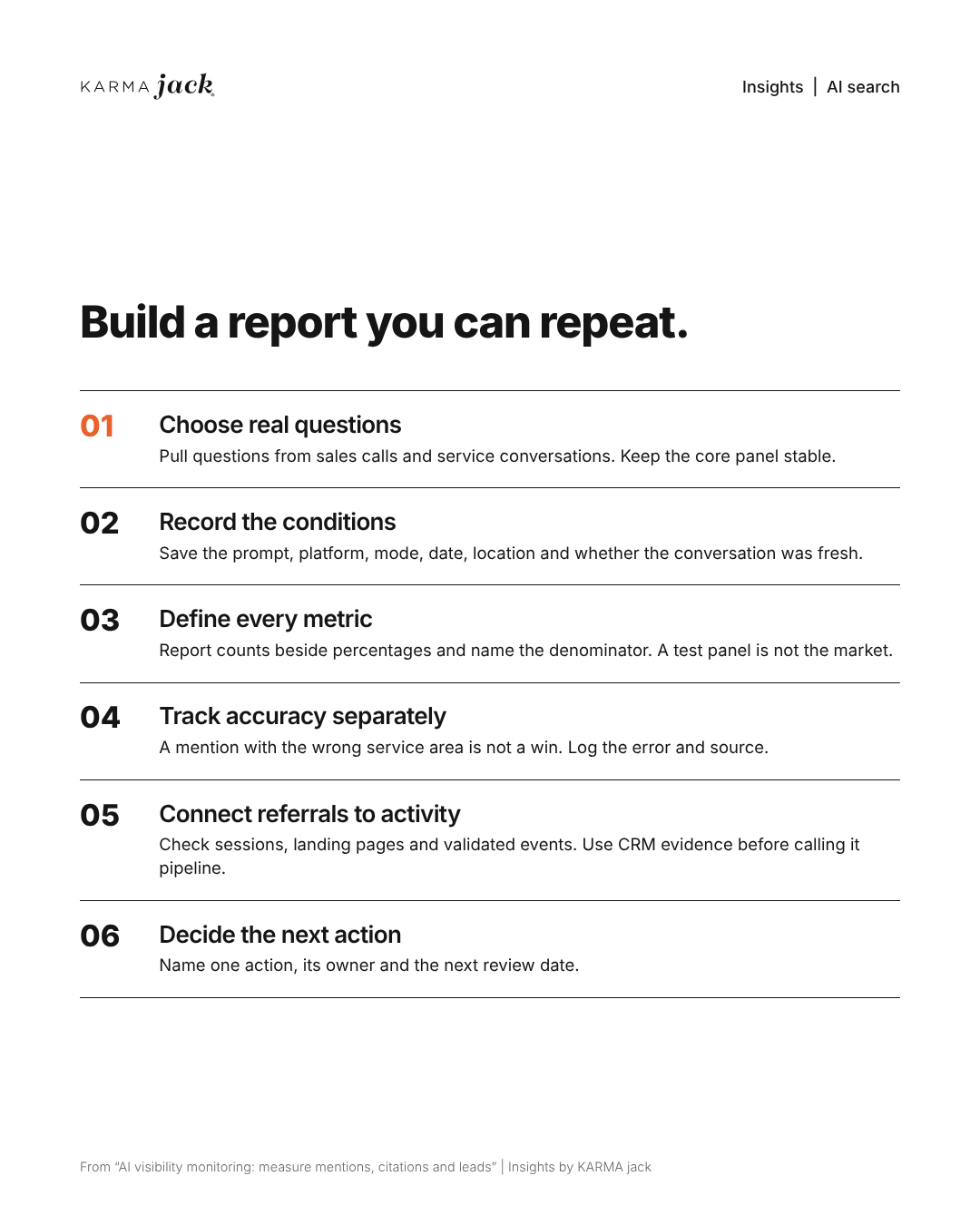
- Write down one action, its owner and the next review date. A report is useful when it helps your team make a better decision.
Choose questions that reflect real decisions
Build a panel of questions from sales calls, customer service conversations and search research. Include branded questions, general category questions, comparisons and location-specific questions where relevant.
Avoid filling the panel with prompts that name your company and then treating the results as evidence of discovery. Someone asking "What does this company do?" is at a different stage from someone asking which provider can solve a problem.
Keep the core panel stable. If you add questions, record when they entered the panel and report them separately until comparisons are meaningful.
The panel describes the questions you chose. It is not a representative measure of every customer or every possible AI search.
Record the conditions of each test
Save the exact prompt, platform, available model or mode, date, language and relevant location settings. Record whether web search was used and whether the test began in a fresh conversation.
Prior conversation, product settings and other context can affect an answer. Do not compare a personalized conversation with a fresh search and call the difference a ranking change.
Save the answer and cited URLs. Repeat a sample of questions to see how much answers vary under similar conditions. If the platform does not produce an AI answer, record that outcome instead of quietly removing it.
Use permitted interfaces and respect platform terms. Automated volume does not make a weak testing method reliable.
Define every metric before reporting it
Mention rate is the number of evaluated answers naming your brand divided by the number of evaluated answers in the stated panel. Citation rate is the number linking to your owned domain divided by that same defined denominator. Report the counts alongside the percentages.
For example, 6 mentions in 30 evaluated answers is 20% for that test panel. It is not 20% of the market. This is a hypothetical calculation, not a KARMA jack or client result.
Track accuracy separately. A mention that gives the wrong service area is not an uncomplicated win. Record the error, its likely customer impact and the source that appears to support it.
If you use "share of voice," define exactly what is counted and how competitors are included. The label alone does not explain the metric.
Connect referrals to meaningful activity
In GA4, the Traffic acquisition report helps identify where sessions originate. Review session source and medium, then inspect the landing pages and business-relevant events associated with those sessions. [1]
Maintain a documented list of observed AI sources rather than assuming one permanent list covers every platform. Test your setup. Source information may be absent or lost, and an AI-influenced customer may return later through another channel.
Check form submissions, calls or purchases only when those events are implemented and validated. Distinguish a form start from a qualified inquiry. Use CRM evidence before calling a visit pipeline or revenue, and avoid counting the same opportunity twice across channels.
A server-log visit from a bot is not a human referral session.
Keep Google search reporting in perspective
Google’s dedicated Generative AI performance report shows impressions from AI Overviews and AI Mode. Google says these insights rolled out worldwide by August 31, 2026; a site may not see the report until it has enough impressions. The documented dimensions are pages, countries, dates and devices. [2] Impressions are not clicks, leads or revenue, and all Google organic traffic should not be labeled AI traffic.
Use search data to understand the broader picture: which pages are gaining or losing traffic, whether important pages are indexed and whether technical changes coincide with performance changes.
A movement in the data is a reason to investigate. It is not automatic proof that one content edit caused the result.
Turn the report into decisions
A practical weekly review can flag inaccurate descriptions, broken pages or sudden measurement changes. A monthly review can examine broader patterns and decide what to improve next. Choose a cadence that fits your volume and the team’s capacity.
Each report should answer three questions: What did we observe? What does it mean for customers? What will we change or test?
Keep technical fixes, editorial improvements and platform variability distinct. If the test method changed, annotate the chart. If a result is too small or inconsistent to interpret, say so.
Common questions about AI visibility monitoring
Can a prompt panel show total market visibility?
No. It measures observed responses to a defined set of questions under recorded conditions. A larger panel can add coverage, but size alone does not make it representative.
Is an AI citation proof of revenue?
No. A citation is a visibility event. Revenue requires additional evidence connecting customer activity to a business outcome, within the limits of your attribution method.
What should be recorded so an AI-answer test can be repeated?
Save the exact prompt, platform, available mode, date, language, location context, search use and conversation state. Keep the answer and cited URLs, and repeat a sample under similar conditions.
How should mention rate and citation rate be reported?
Define the evaluated-answer denominator. Count answers naming the brand separately from answers linking to the owned domain, show counts alongside percentages and report accuracy separately. These rates describe the test panel.
Does an AI crawler visit count as a customer referral?
No. A bot request in server logs is not a human referral session. Use validated analytics for observed visits and CRM evidence for qualified inquiries or revenue, while keeping attribution gaps visible.
Match the finding to the next action
- Wrong business details: verify the cited page, correct information you control and log the change. Recheck the same question under the same conditions.
- Relevant mentions but few visits: inspect whether the answer provides a link and whether that link answers the buyer's next question. Do not assume every mention should produce a click.
- Visits without qualified inquiries: test the landing page, mobile contact path and tracking. Ask sales what makes an inquiry useful before changing the conversion target.
- Too little data to judge: keep the observation, disclose the small sample and continue the same method. Avoid increasing spend based on a single favorable answer.
Build a report you can act on
Choose a stable question set, define the metrics and validate the traffic data. Then put the next decision beside the numbers.
Talk with KARMA jack about connecting search visibility with the business outcomes that matter. [3]
Sources
[1] Google Analytics: GA4 Traffic acquisition report
[2] Google Search Console: Generative AI performance report (Search)

