AI search for veterinary hospitals starts with accurate services, location details and a clear appointment path. Help a pet owner understand whether the hospital treats their animal, accepts new patients and offers the care they are seeking.
AI-powered search can become one place those questions are answered. A hospital’s job is to make its public information accurate, useful and easy to find. No agency or website change can guarantee that an AI system will recommend a particular practice.
Hospital owners and practice managers should prioritize one service the team has capacity to deliver, one accurate location page and one dependable appointment path. This creates useful work to do now while search systems change. Judge progress by suitable inquiries and completed visits alongside visibility observations.
What does AI search mean for veterinary hospitals?
AI search presents generated answers alongside, or instead of, a traditional list of results. For hospitals, the useful opportunity is helping people understand the practice before they contact it.
Google’s guidance on AI features says established SEO practices still apply. Pages need to be indexed and eligible for a search snippet to qualify as supporting links. Eligibility does not guarantee inclusion. Google’s AI search guidance is a better starting point than a promise of a special shortcut.
A pet owner’s urgent medical question also needs a different response from a new-client inquiry. Public content should direct urgent concerns to a veterinary professional, rather than position a general AI answer as a substitute for care.
Make the hospital easy to understand
Review the homepage and location page as if you have never visited the practice. State the animals treated, core services, actual hours, address, phone number and appointment process. Explain any referral requirements or limits on emergency availability.
Describe real staff credentials and services in plain language. A page about dentistry should explain what the hospital offers and how an owner can ask about an assessment. It should not promise that every animal needs the same procedure.
Keep important information in readable page text. A photograph of a flyer is a poor place to put the only explanation of your hours or booking instructions.
Keep local information connected
Compare the hospital website with its Google Business Profile and other maintained listings. Correct conflicting phone numbers, old names, moved addresses and inaccurate hours. Match the real-world business identity rather than adding search phrases to its name. Google’s Business Profile guidelines explain those requirements.
Give one person ownership of changes. When holiday hours change or a service pauses, update the relevant channels together. A small maintenance routine is more useful than a large audit that nobody acts on.
Prioritize the page that can resolve the next client’s question
Have the practice manager and reception lead choose one demand the hospital can actually serve: routine new-client visits, an offered specialty or a defined referral service. List the questions that prevent a suitable caller from booking. Build the first page around those answers before commissioning a broad article calendar.
For a routine first visit, the page should name the species accepted, explain how availability is confirmed, link to the correct location and tell clients how to transfer records through an approved route. For a referral service, state whether a referring veterinarian is needed and how that veterinarian can send records. Do not mix these routes into an unexplained generic contact form.
Give the medical director the health-related wording and reception the logistics. Ask each reviewer to identify the source for their facts and who will update them. The website editor should keep the answer in visible page text, use descriptive links and check that the phone button and request form work on mobile.
Publish answers the team can stand behind
Start with questions reception staff hear repeatedly. Explain what a first appointment involves, what records to bring, how referral visits work and how to request a refill review. Have a veterinarian review material that discusses animal health.
Use a clear question, a direct answer and enough detail to help the reader take the next step. Add sources where claims need support. Do not create dozens of nearly identical articles just to cover variations of a search phrase. Combine overlapping questions on one useful page.
Ask for honest feedback through a consistent review process. Never invent reviews, filter requests to only happy clients or ask AI to impersonate a pet owner.
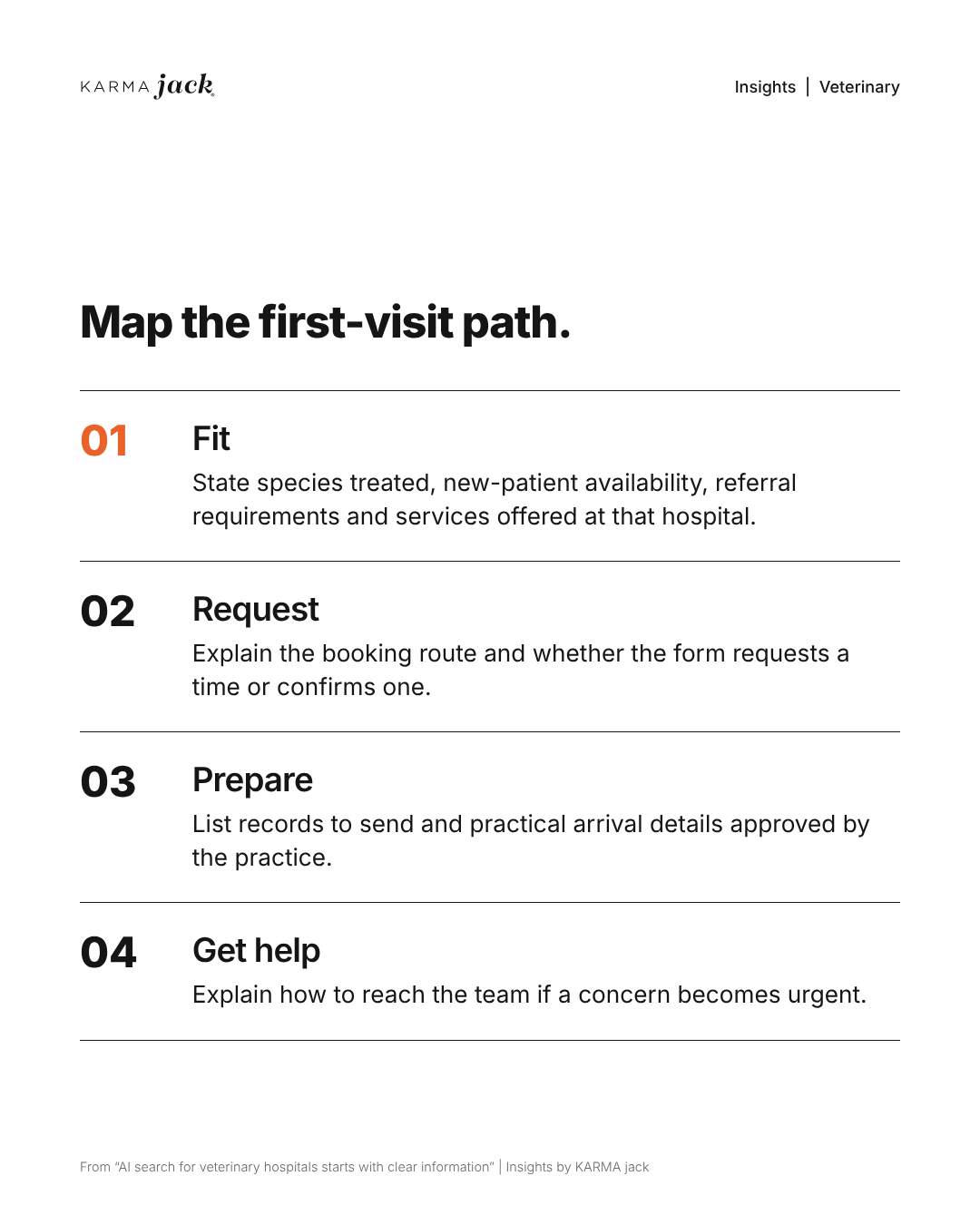
Map the first-visit path
Use one first-visit page to answer the questions that affect a new client’s decision:
- Fit: State the species treated, new-patient availability, referral requirements and services actually offered at that hospital.
- Request: Explain the booking route and whether submitting the form requests a time or confirms an appointment. Give the team’s actual response window.
- Prepare: List records to send and practical arrival details approved by the practice. Link to current forms rather than copying private records into marketing tools.
- Get help: Explain how to reach the team if the appointment is unsuitable or a concern becomes urgent. Use the practice’s veterinary-approved escalation route.
Have reception test the complete path on a phone and have a veterinarian check health-related wording. Record the page owner and review date, then update the page when hospital policies change.
How should a hospital measure AI search visibility?
Keep a small, repeatable set of relevant search questions and record the date, location context and answer observed. Treat those checks as samples. A single answer does not establish market-wide visibility.
Compare that research with website inquiries, tracked calls and completed new-client appointments where your systems support it. Record the limits of attribution. An AI mention, a visit and a booked appointment are different events.
Separate a search problem from an intake problem
Review this five-step customer path:
- Relevant search visibility
- Page visit
- Qualified inquiry
- Confirmed appointment
- Completed first visit
Review each step with its limits. A call click does not prove that someone reached reception, and a form submission does not prove the animal was eligible for the offered appointment.
If the page gets visits but callers repeatedly ask whether the hospital treats their species, make that answer easier to find. If qualified requests arrive but no suitable appointments are available, clarify capacity and reconsider the campaign. If search answers repeat old hours, correct the maintained source and record the later check.
Track the same few location-specific questions over time, but avoid a numerical AI score based on a handful of responses. Google now provides a Generative AI performance report for impressions in supported Search features. Those data also remain within the broader Web performance report. An impression is not a click, inquiry or completed visit. Do not label a whole increase in web search activity as AI-generated demand; report missing source information as unknown. See our AI search visibility guide for the broader measurement framework.
At a monthly review, choose one correction from the evidence, assign an owner and record when the next check will happen. This gives the hospital a practical improvement cycle even when AI attribution remains incomplete.
Veterinary search questions
Which veterinary page should we improve first?
Choose a service the hospital can actually deliver and a question that prevents suitable clients from booking. Connect that answer to the correct location, referral requirements and a tested appointment route.
What should a first-visit page explain?
State the species and services offered, availability, referral requirements and whether a form requests or confirms an appointment. Add approved records instructions and a clear route to the team for help.
What if search traffic grows but completed first visits do not?
Check the steps between the visit and completed appointment. Review inquiry fit, reception contact, capacity, confirmations and cancellations separately. A call click or form submission does not establish a completed visit.
Build a clearer path to your hospital
KARMA jack helps businesses connect marketing strategy, content and technology. Start a conversation about making your hospital easier to find and understand.