
AI search visibility starts with useful public content, accessible pages and accurate information. Check what platforms can reach, what their answers cite and whether measurable visits become qualified business outcomes.
Is GEO different from SEO?
AI SEO, GEO and AEO are overlapping industry labels for improving visibility in AI-assisted discovery. They are not separate platform certifications or guaranteed placement services. Google describes its generative search optimization as SEO. [1]
Google says a supporting page must be indexed and eligible for a search snippet to appear in AI Overviews or AI Mode. It does not require special AI markup. Eligibility is not a promise of indexing, citation or traffic. [2]
Give readers something useful
Google’s current guidance emphasizes original value, clear organization and relevant images or video. It warns against publishing large numbers of pages mainly to manipulate search or AI responses. A different headline on the same generic article does not create a useful resource. [1]
Our editorial test: does this page help someone make a better decision? Add an original comparison, practical method or expert interpretation. Explain the evidence and its limits. Separate facts from recommendations.
Treat citation tactics as tests
The GEO research paper reports visibility improvements in its benchmark and says effects vary by domain. Its latest listed revision is June 2024. It does not establish a universal 2026 ranking formula. Clear writing and citations are sensible editorial choices, not guaranteed placement factors. [3]
Check access deliberately
Search access, model training and privacy are different decisions. Before changing controls, document what the business wants accessible and have the website owner verify the technical effect.
Googlebot and page-level indexing or snippet directives affect Search access and presentation. Blocking crawling in robots.txt does not necessarily remove a URL from results. It is not a way to protect confidential material. Use access controls for private information. [4]
Google announced new Search Console AI-feature controls and reporting in June 2026. Its August 31 update confirms worldwide rollout. Review the site’s current inclusion settings before making changes. Do not apply a sitewide exclusion without understanding the traffic tradeoff. [1], [5]
Does blocking GPTBot remove a site from ChatGPT search?
OpenAI documents separate controls: OAI-SearchBot supports search inclusion; GPTBot concerns possible model training use. A site can allow one and disallow the other. Opting out of OAI-SearchBot excludes content from ChatGPT search answers, but navigational links may still appear. [6]
ChatGPT-User handles some user-initiated visits. It is not the automatic search crawler, and robots.txt rules may not apply to those visits. That distinction makes a simple allow-all or block-all AI policy unreliable. [6]
Content changes
Keep useful pages linked within the site. If the CMS supports IndexNow, use it to notify participating engines about meaningful additions, updates or removals. A notification does not guarantee crawling or immediate indexing. Check the actual outcome rather than promising an indexing deadline. [2], [7]
Measure the whole journey
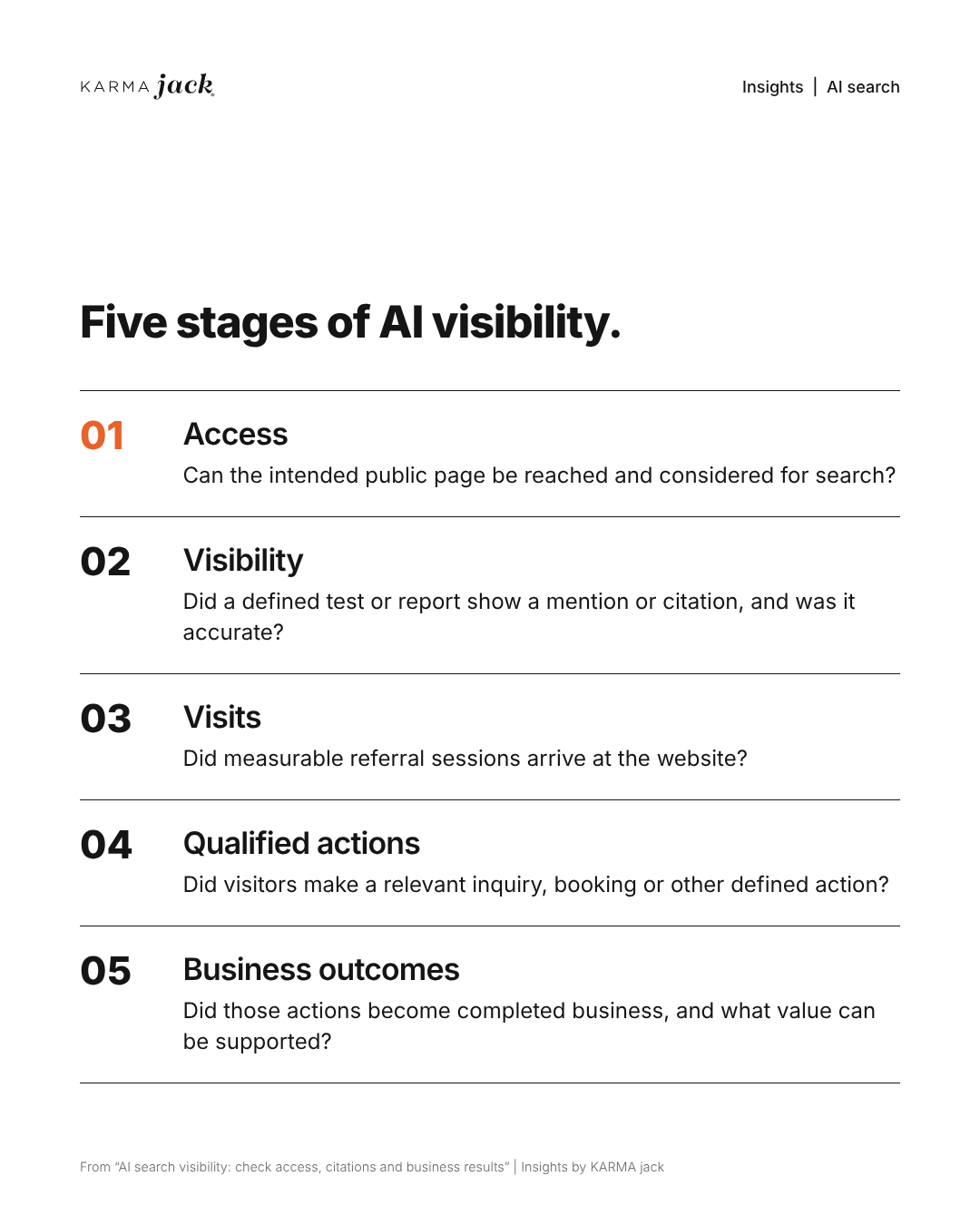
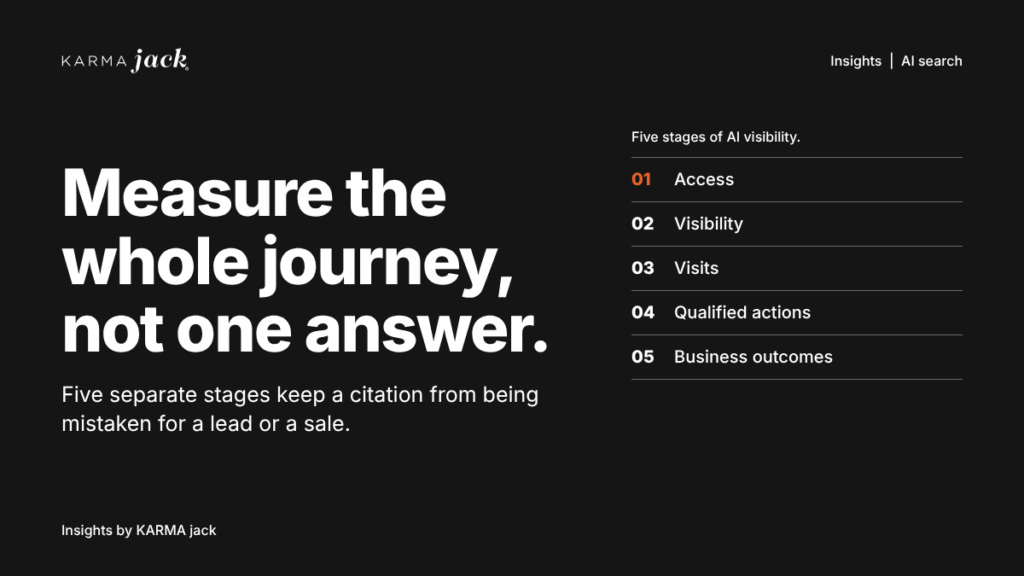
Use five distinct stages in the review:
- Access: can the intended public page be reached and considered for search?
- Visibility: did the defined test or platform report show a mention or citation, and was it accurate?
- Visits: did measurable referral sessions arrive at the website?
- Qualified actions: did those visitors make a relevant inquiry, booking or other defined action?
- Business outcomes: did the recorded actions become completed business, and what value can be supported?
For each stage, record the source, definition, owner, time period and missing data. A gap between stages is a question to investigate, not a number to fill with an assumption.
Know what each report covers
Google’s technical documentation includes AI-feature traffic in the Search Console Web report. Its newer guidance also points to a Generative AI performance report, and its August 31 update confirms worldwide rollout of the new features. Check report definitions before comparing results. [1], [2], [5]
Bing announced Topics Portfolio in October 2026 as a beta within AI Performance. It groups grounding queries into topics and provides approximate ecosystem measures. It needs sufficient data, uses AI-generated classifications and shows some volumes as ranges. Treat it as directional Microsoft/Bing evidence, not a census of all AI platforms. [8]
Use a repeatable test
Choose a fixed set of real buyer questions and record:
- Platform
- Date
- Geography
- Account state
- Exact question
- Cited URL
Repeat the sample rather than changing the questions to find a favorable answer.
Review referral sessions alongside qualified inquiries and CRM outcomes. Keep attribution gaps visible. A sample of AI answers cannot measure every conversation, and an increase after a website edit does not establish that the edit caused it.
Make the next improvement clear
Start with a small set of high-value pages. Fix access problems, improve unsupported or unclear content, and record the changes. Review results over a consistent period. Keep what helps readers and produces useful business outcomes. Recheck platform guidance before each substantial update.
Give the first review a clear owner
Have the marketing lead choose one buying decision and its public page. The web owner checks access; the subject specialist verifies the answer; sales defines a useful inquiry. Record the current page, the problem, the approved change and the review date in one log.
For an HVAC business, the page might explain an actual repair service and service area. For a manufacturer, it might answer application-fit questions and invite a technical inquiry. Use the same access, accuracy and customer-action checks, but adapt the content to the decision each buyer faces.
KARMA jack‘s SEO services include technical, local and on-page work. Connect those checks to a useful page and a measurable next action before expanding the content plan.
AI search visibility questions
Which stages belong in an AI visibility review?
Separate access, observed visibility, referral visits, qualified actions and completed business. Give each stage a definition, source, owner and period, and leave missing data visible instead of filling gaps with assumptions.
Can robots.txt protect confidential business documents?
No. Crawler directives are not access controls. Keep private documents and account pages protected with appropriate permissions, and review public search access as a separate decision.
How can an AI visibility test avoid cherry-picking?
Use a fixed set of real buyer questions and record the platform, date, geography, account state, exact question and cited URL. Repeat that sample consistently and retain unfavorable results.
Sources
Public sources checked October 27, 2026. Platform documentation describes its own product, not a universal model of AI search. Features and reports may vary by account or change after this review.
1. Google Search Central | Optimizing your website for generative AI features on Google Search. Current official guidance; accessed October 27, 2026.
2. Google Search Central | AI features and your website. Technical eligibility, content and reporting guidance; accessed October 27, 2026.
3. Aggarwal et al. | GEO: Generative Engine Optimization. KDD 2024; arXiv revision June 28, 2024. Benchmark findings are not current cross-platform performance guarantees.
4. Google Search Central | Introduction to robots.txt. Updated December 10, 2025. Crawl control is not a confidentiality safeguard.
5. Google | New opportunities, control and insights for website owners. June 3, 2026; updated August 31, 2026. The update confirms worldwide rollout.
6. OpenAI | Overview of OpenAI Crawlers. Current search, training and user-action distinctions; accessed October 27, 2026.
7. IndexNow | FAQ. Submission and indexing limitations; accessed October 27, 2026.
8. Microsoft Bing | Introducing Topics Portfolio Beta in AI Performance. October 13, 2026. Approximate measures and data-availability limitations.

