
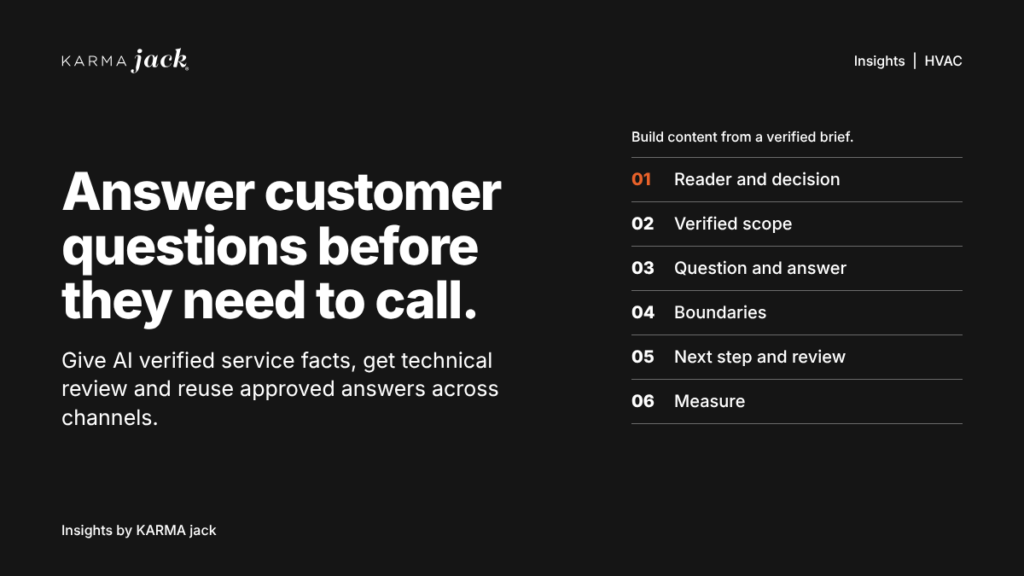
AI marketing content for HVAC should answer a homeowner’s next question using verified service facts. Build a brief, have a qualified person review technical claims and reuse the approved answer across the channels your team can support.
AI can help turn those questions into drafts, outlines and campaign variations. Useful HVAC content still depends on accurate service information, technical review and a next step your business can deliver.
Start with questions from actual conversations
Ask dispatchers, technicians and estimators what people repeatedly need explained. Work from themes rather than copying identifiable customer conversations into an unapproved tool.
Pick a question tied to a decision. A maintenance page can explain the actual scope of a visit. A replacement article can describe what an estimator considers without declaring that every system of a certain age must be replaced.
Write a short, direct answer near the top. Then explain the details, limits and next step. That structure helps a reader decide whether the page is useful without digging through a long introduction.
Use a brief your reviewer can approve
Supply verified facts about your operation. If there is no confirmed price, financing term or response-time commitment, leave it out. Do not ask AI to fill those gaps creatively.
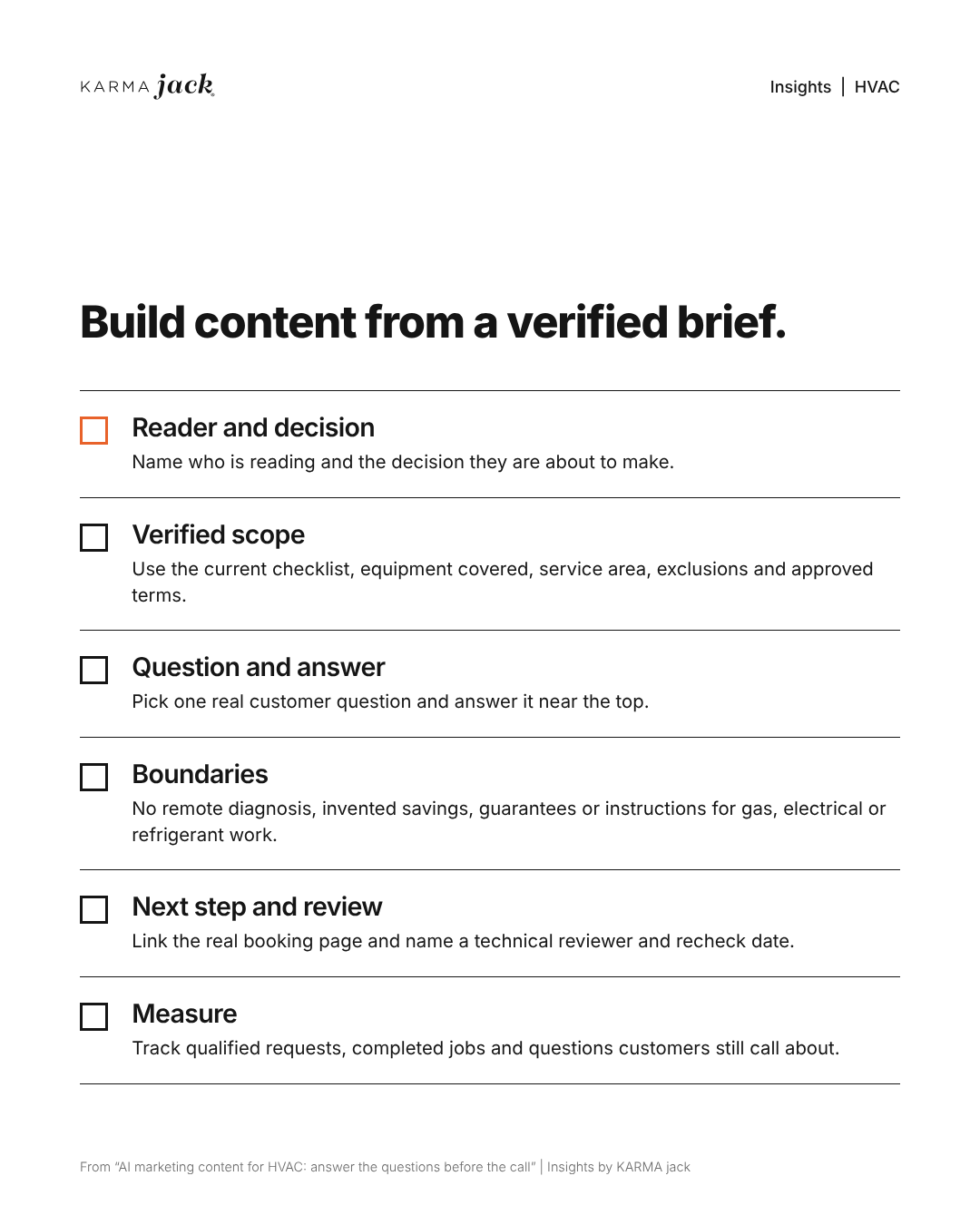
For a maintenance explainer, complete these fields before asking for a draft:
- Reader and decision: A homeowner deciding whether to request a maintenance visit for a system your company services.
- Verified scope: The current service checklist, equipment covered, actual service area, exclusions and approved terms. If the checklist is unavailable, stop before describing what the visit includes.
- Question and answer: “What happens during a maintenance visit?” Answer from the checklist, then explain what needs an on-site assessment.
- Boundaries: No remote diagnosis, invented savings, guaranteed breakdown prevention or instructions to open electrical, gas or refrigerant components.
- Next step and review: Link to the real appointment-request page. Name the technical reviewer and editor internally, and set a date to recheck scope and availability.
- Measure: Track qualified requests and completed jobs where attribution is available. Use repeated customer questions to identify what the page still needs to explain.
Have a qualified subject-matter reviewer check technical statements. Keep repair instructions within the safety boundaries of the content. A marketing article should not encourage readers to work on gas, electrical or refrigerant systems.
Publish useful local detail
A service-area page should explain something meaningful about the work available in that area. That might include real service coverage, relevant building types or a documented project the company has permission to share.
Swapping city names across dozens of otherwise identical pages gives readers little help. Do not invent offices, local teams or customer stories to make a page feel specific.
Google’s scaled content abuse policy covers generating many pages primarily to manipulate rankings rather than help users, including AI-generated pages without added value. Its guidance on generative AI content emphasizes accuracy and review, including metadata. Production speed is useful only when the result earns its place on the site.
Prepare seasonal content before you need it
Build a small set of approved seasonal assets while the team has time to review them. A maintenance reminder, a service explainer and an appointment page can share a consistent message.
Before launch, recheck availability, offer terms and the actual conditions in the service area. Do not keep an emergency-service promise in circulation after dispatch capacity changes.
Support the full experience in each language
If customers need Spanish-language information, involve a fluent reviewer familiar with HVAC terminology. Confirm that forms, appointment confirmations and the team answering inquiries support the experience you advertise.
Where separate language pages exist, your web team can use Google’s localized-page guidance to identify the alternate versions correctly.
Do not infer a community’s language needs from a stereotype or promise bilingual support that is unavailable.
Build three useful assets from one verified service brief
Repurpose a sound article into a short video outline or an email, but adapt it to the channel. A social post may answer one question and link to the full explanation. It does not need the entire article squeezed into a caption.
For a replacement-estimate topic, begin with the service manager’s explanation of what the appointment assesses, the estimator’s actual process and the company’s approved service area. Have an editor turn those inputs into a page that helps a homeowner prepare, rather than a generic list of reasons to buy.
Then create a short email pointing to the preparation page and a short video outline in which a real qualified team member explains one common question. Each asset should use the same verified facts and appointment route. Changing a format does not permit a new promise about savings, equipment lifespan or financing.
Keep a claim register with these fields:
- Statement
- Supporting source
- Reviewer
- Recheck trigger
Offer terms should be reviewed when the offer changes; service scope when operations changes; technical claims when the source or equipment guidance changes. Remove an expired claim from every reused asset, including scheduled messages.
Sample AI instruction: Use only this approved brief; explain the homeowner’s next decision; flag missing facts; do not invent a price, result, testimonial or service.
A person still checks the output. The prompt is a control, not proof that the draft is accurate.
Choose maintenance work before a larger publishing calendar
Ask the website editor to inventory current service pages, the customer question each page answers and the next action it offers. Mark pages that compete for the same question, have expired offers or lead to an unavailable service. Fix those gaps before ordering more articles.
Use a small editorial queue with a decision, source owner, technical reviewer and distribution plan for each item. A page is ready when a homeowner can understand the service, the limitations and the actual next step. A full keyword list is not an acceptance test.
After release, collect recurring questions from reception without copying private conversations into the content tool. If readers still ask what the appointment includes, revise the scope section. If the business cannot handle more replacement estimates this week, adapt the promotion rather than stretching the content promise.
Measure what readers do next
Track service-page visits, qualified inquiries and booked jobs where your measurement setup supports the connection. Separate informational traffic from customers ready to schedule.
Review which questions still lead people to call for clarification. Improve existing content when it leaves a gap. More articles are not always the most useful next step.
KARMA jack helps HVAC companies connect creative and marketing with business decisions. Talk with our team about a content plan built around the questions your customers actually ask.
Questions HVAC owners ask
Is AI-written content automatically bad for SEO?
No. The useful questions are whether it is accurate, original, relevant and valuable to readers. Publishing at scale without value can create problems.
Should every service area have its own page?
Only when the page offers meaningful, accurate information. Avoid near-duplicate pages created just to target city names.
How often should an HVAC company publish?
Choose a pace your team can research, review and maintain. A smaller set of useful pages is a better starting point than a schedule full of filler.
What facts should an HVAC content brief verify before drafting?
Confirm service scope, equipment covered, service area, exclusions, approved terms and the real next step. Name the technical reviewer. Leave out unconfirmed prices, savings, financing terms and response-time promises.
What should be checked before offering HVAC content in another language?
Use a fluent reviewer familiar with HVAC terms and confirm that forms, confirmations and the staff answering inquiries support the advertised experience. Do not promise bilingual service that is unavailable.
How should reused service claims stay current?
Maintain a record of each statement, supporting source, reviewer and recheck trigger. Update affected pages, emails, videos and scheduled messages when service scope or offer terms change.

