
Insights by KARMA jack | Paid media
You approved a monthly ad budget. Two weeks later, one location has used most of its allocation while another has barely spent. The total can still look fine. The plan is drifting.
Budget pacing means checking how quickly you are spending against the plan, then deciding whether the difference needs attention. Give that review an owner, a consistent rhythm and a clear record of changes. You will have a better conversation than “Why did we spend that much?” after the month closes.
The short version
- Compare spending with the plan you approved, not just the calendar.
- Check each location. A healthy total can hide uneven spending.
- Review business results before changing a budget.
- Name the decision owner and the next review date.
Start with the budget you actually approved
Write down the media budget, dates, platforms and locations it covers. Keep agency fees, production costs and taxes separate unless the approved total explicitly includes them. Use one currency and a consistent reporting cutoff.
Next, record how spending should unfold. A steady service campaign may have a roughly even plan. A promotion may deliberately spend more before its deadline. A location with limited appointment capacity may need a smaller allocation. Make those choices visible before comparing actual spend with the calendar.
For a multi-location business, review each location as well as the total. An underspend in one market can hide an overspend in another.
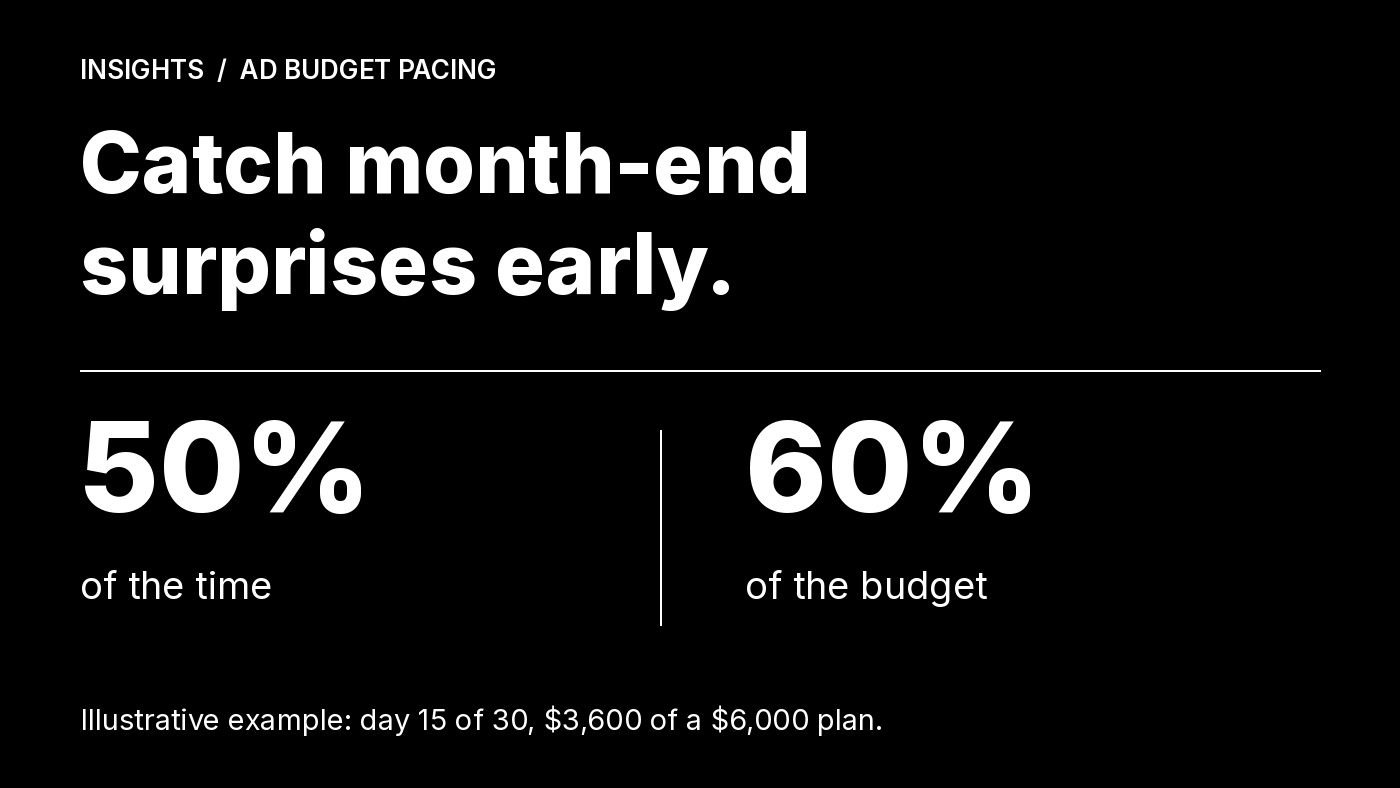
Half the month. How much of the budget?
For a deliberately even plan, divide elapsed days by total campaign days, then compare that percentage with the percentage of budget spent. Treat the result as a prompt to investigate, not an automatic instruction to change a campaign.
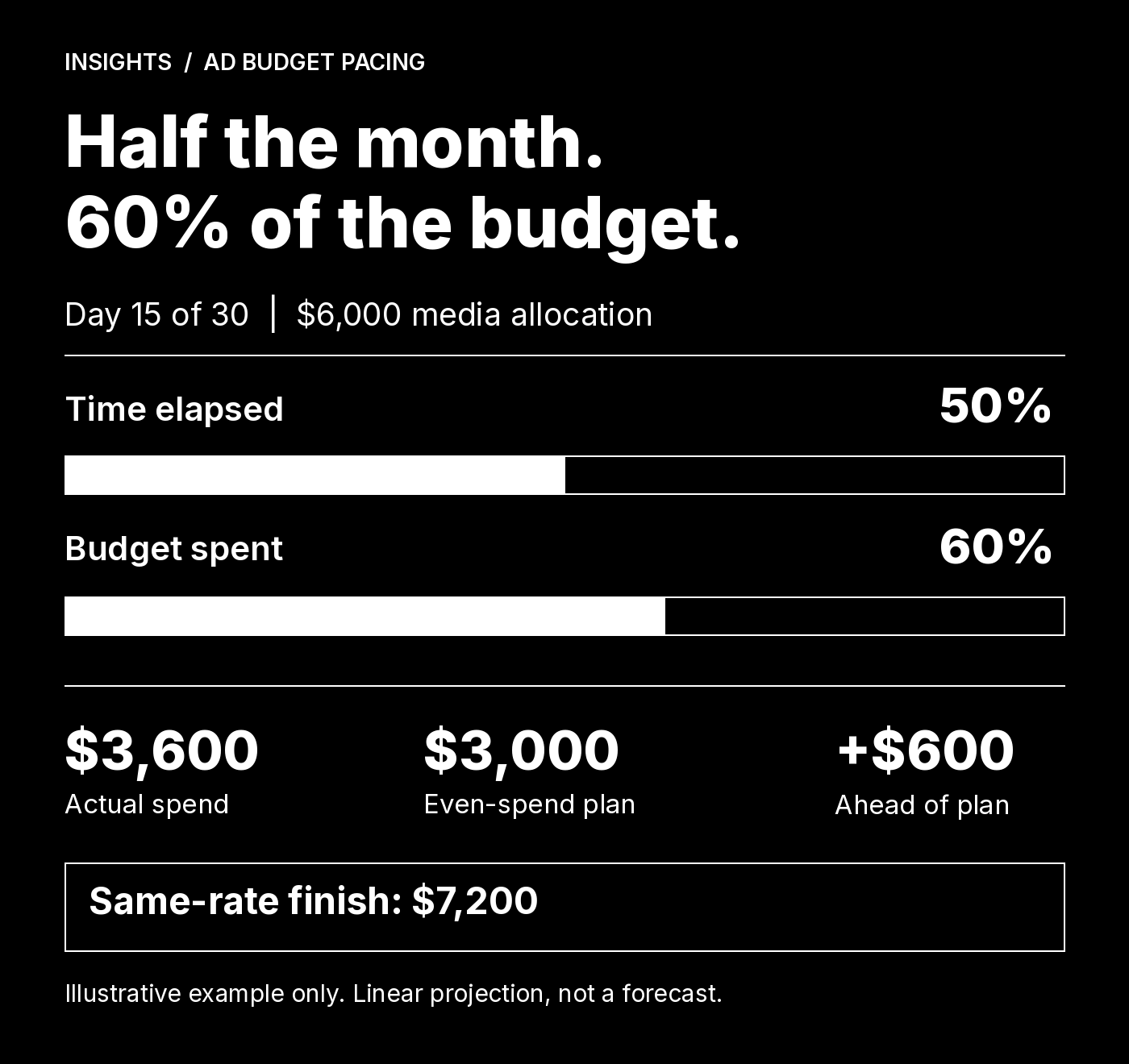
Illustrative example only. A 30-day campaign has a $6,000 media allocation. After 15 complete days, half the time has passed and 60% of the budget is spent. The straight-line plan is $3,000.
Three calculations to keep handy
Expected spend: allocation × completed days ÷ total days
Difference: actual spend − expected spend
Simple projected finish: actual spend ÷ completed days × total days
In this example: $6,000 × 15 ÷ 30 = $3,000 expected. $3,600 − $3,000 = +$600. $3,600 ÷ 15 × 30 = $7,200 projected.
At the same average rate, the campaign would finish at $7,200. That is a simple projection, not a forecast of what the platform will actually spend. Demand, schedules and recent changes can alter the result. Check the campaign’s settings and spending limits before deciding what to do.
The total can hide the problem
Imagine two locations with equal $3,000 allocations and an even 30-day plan. At day 15, the combined spend is exactly where you expected. The location view tells a different story.
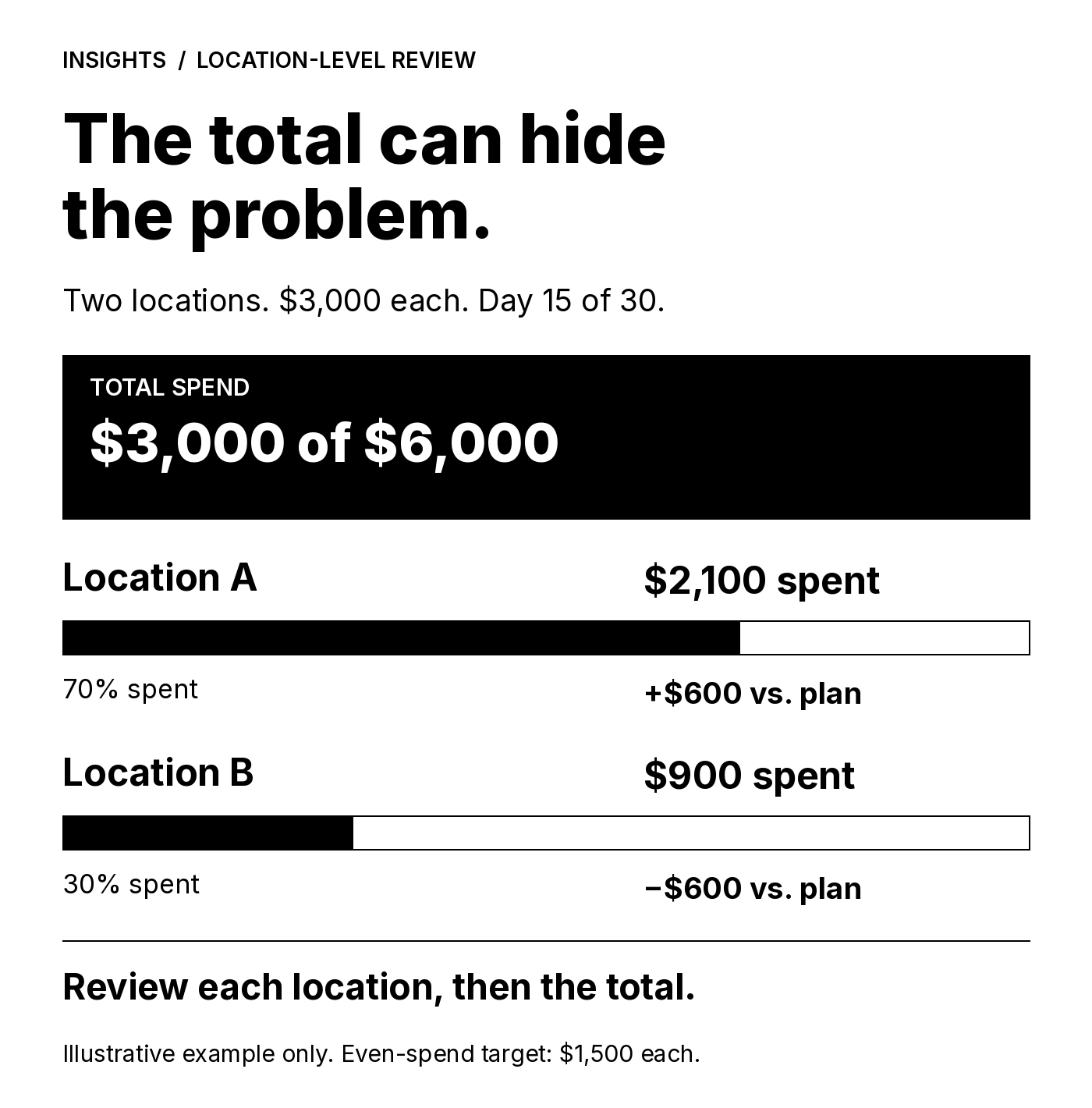
- Location A: $2,100 spent versus $1,500 planned. $600 ahead.
- Location B: $900 spent versus $1,500 planned. $600 behind.
- Combined: $3,000 spent versus $3,000 planned. The total looks on pace.
Illustrative example only. These are invented figures, not client results.
Ask why the difference exists. Demand, appointment capacity and a deliberate promotion may explain it. A broken form or a delivery restriction may also be involved. Do not move money between locations until the right person approves the change.
Understand what a daily budget controls
In Google Ads, an average daily budget is not a promise to spend exactly that amount every day. For most campaigns, the daily spending limit is twice the average daily budget and the monthly limit is 30.4 times it. Changing the budget during the month affects the limits. Review Google’s current spending rules for your campaign type before treating a setting as a monthly cap.
Where supported, Google’s budget report shows cost to date, a monthly forecast and budget changes. Its current help page excludes Performance Max from that report. Use the reporting available for the campaign you are reviewing instead of assuming every campaign has the same view.
An approved allocation is a business decision
A platform budget setting controls delivery within that platform’s rules. Keep both visible. A setting that looks right does not replace a check against the total you approved.
Pair the spending check with a business check
Before changing a budget, ask what the spending is producing and whether the business can serve the demand. A campaign that is behind plan may have a broken destination, restricted delivery or limited demand. Increasing its budget alone may not solve the problem.
A campaign ahead of plan deserves the same care. Review the quality of inquiries, recent changes, available capacity and the remaining approved allocation. Good results do not automatically authorize a higher total.
Choose the outcome that matters to the campaign, such as a qualified inquiry or a completed sale. Keep its definition consistent. A lower cost per recorded action is hard to interpret if one report counts phone clicks and another counts confirmed customers.
Make the next decision before the last week
A practical starting point is a planning check early in the week and a follow-up later in the week. Add closer checks as a short promotion or month-end deadline approaches. Higher-spend or fast-changing campaigns may need more frequent monitoring.
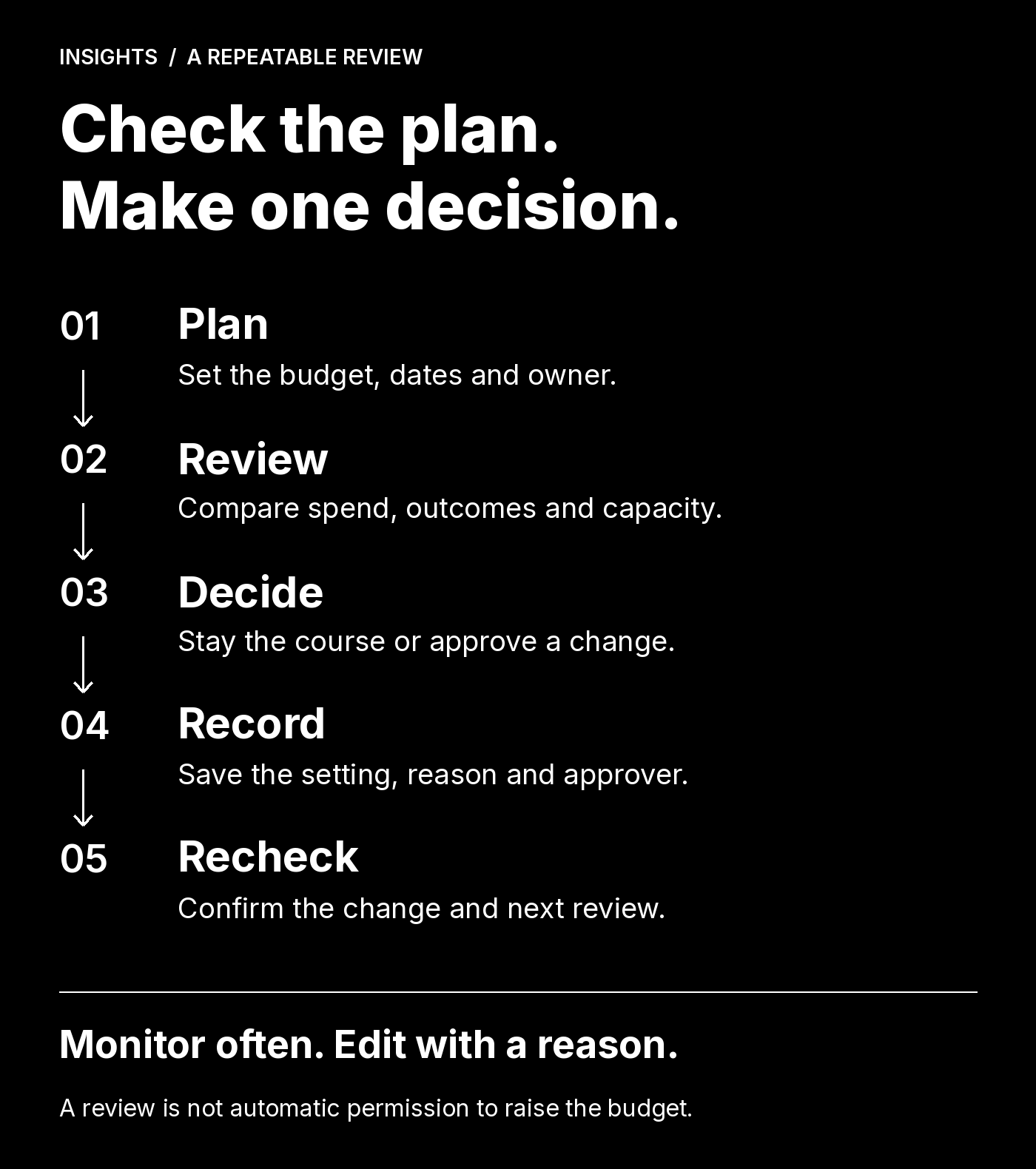
- Plan: record the allocation, dates and expected spending pattern.
- Review: compare actual spend with the plan and check business results.
- Decide: keep, investigate or adjust within approved limits.
- Record: note the old setting, new setting, reason and approver.
- Recheck: confirm the change happened and review its effect.
Use the early check to identify exceptions. Use the later check to confirm whether the agreed changes happened and whether the projection has shifted. Keep monitoring separate from making changes: looking every day does not require editing every day.
Assign one person to maintain the pacing record and one person to approve changes outside the agreed limits. Record the review date so the next person can understand what happened.
Bring one decision to the meeting
Your update can fit in a few lines. Copy this structure into your next campaign review.
Your pacing update
Approved allocation: amount, dates and scope
Actual spend: amount through a stated cutoff
Expected spend: amount based on the agreed plan
Projected finish: amount and assumptions
Business outcome: the result and its definition
Recommended action: what should happen next
Owner / next review: name and date
For example: “We are $600 ahead of our even-spend plan. The promotion ends next week, so some front-loading was intentional. The buyer will check the remaining allocation today and return with a recommendation. No increase to the approved total is requested.”
That example is invented, but the discipline is useful. State the difference, explain what you know and make the next decision clear.
Questions worth asking
Does being ahead of pace mean we should cut spend?
No. First check the planned spending pattern, results, remaining allocation and business capacity. A deliberate promotion may justify front-loading. A change outside the agreed limits still needs approval.
Is a straight-line projection a platform forecast?
No. It extends the average rate so far. It does not account for future demand, schedules, platform limits or recent campaign changes.
How often should we review?
Start with an early-week check and a later follow-up. Increase the review frequency for high spend, short promotions or fast-changing conditions. A review does not require an edit.
Start with one campaign this week
Agree on its budget, review dates and decision owner. Once that record is useful, apply the same structure across the account.
Want a clearer view of your paid media? Talk with KARMA jack about the plan behind your spend.
Explore paid media & advertisingPlatform references checked November 16, 2026. All numerical examples are illustrative. Review the linked Google Ads documentation for current campaign-specific rules.
