
If you sell warehouse equipment, your next website improvement should help a buyer decide whether your product fits a specific operation. Start with one profitable application, publish the technical answers buyers need, connect those answers to a project inquiry, then promote that page through search and your integrator network.
That gives your marketing a clear job: earn a qualified engineering conversation. It also gives search engines and AI tools useful material to understand and reference.
The opportunity is in the buying questions
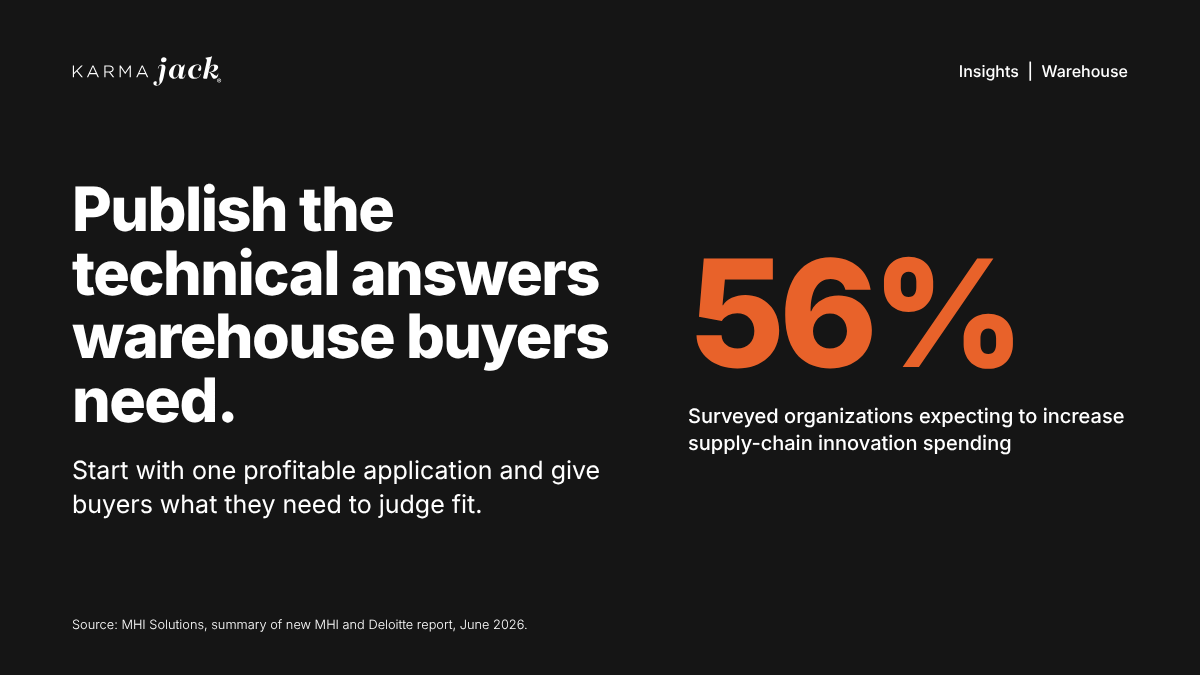
56%
Surveyed organizations expecting to increase supply-chain innovation spending
MHI’s June 2026 summary of its research with Deloitte says 56% of surveyed organizations expect to increase supply-chain innovation spending. Yet unclear use cases, costs and business-case difficulty remain barriers. This measures broad spending intentions, not demand for an individual supplier’s equipment. [1]
You can address that hesitation with content that helps a buyer evaluate a real decision. “Warehouse automation” covers an enormous range of projects. “What information do I need to specify a carton chute?” gives you a much clearer starting point.
1. Build one application page around a real sales opportunity
Choose an application that your sales and engineering teams want more of: carton movement between levels, order consolidation at a put wall, or a packing workstation for a defined product mix. Interview the person who handles those inquiries. Ask which missing details delay a quote and which requirements make a project unsuitable.
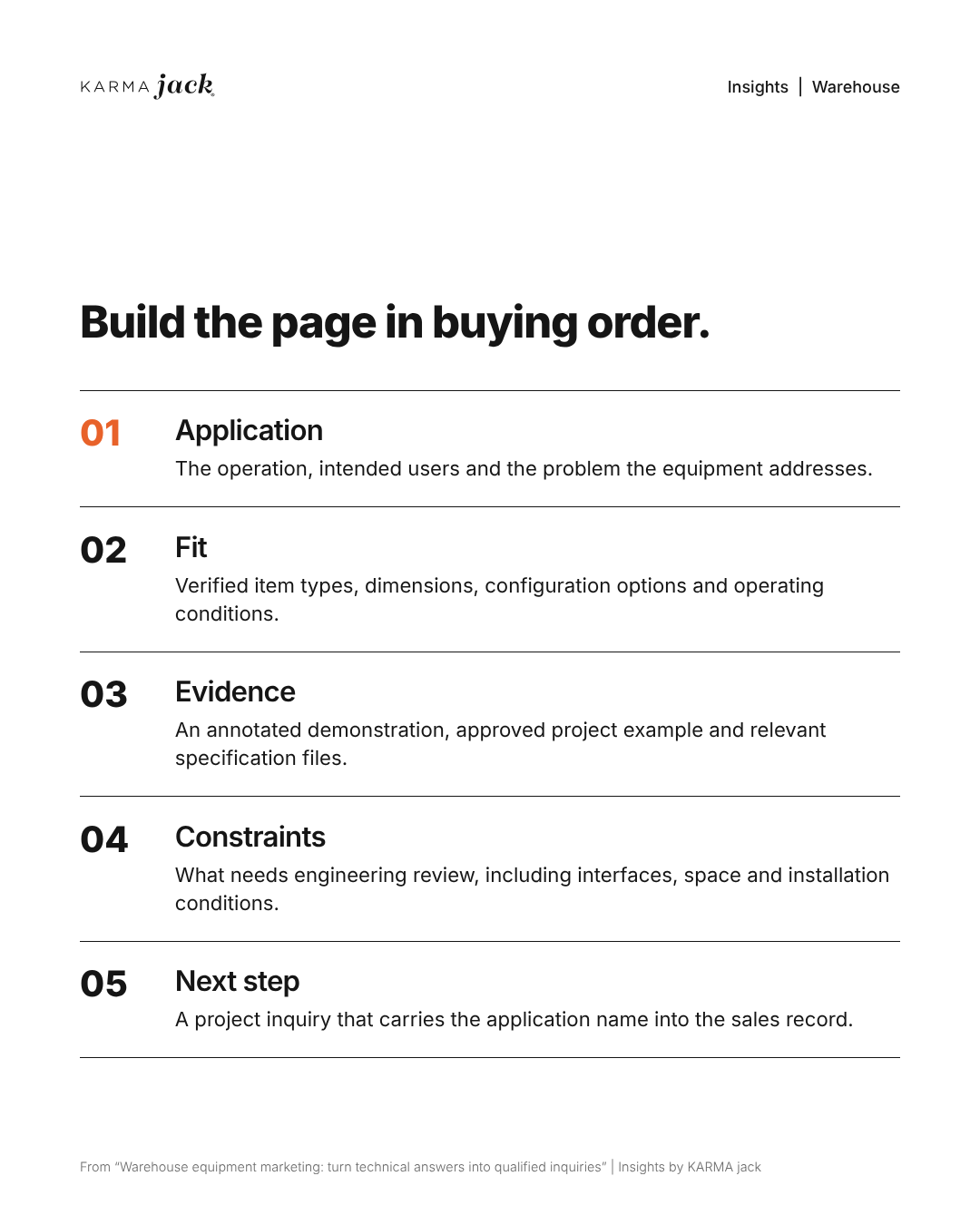
Then build the page in the order a buyer evaluates it:
- Application: the operation, intended users and problem the equipment addresses.
- Fit: the verified item types, dimensions, configuration options and operating conditions.
- Evidence: an annotated demonstration, approved project example and relevant specification files.
- Constraints: what needs an engineering review, including interfaces, space and installation conditions.
- Next step: a project inquiry that carries the application name into the sales record.
Example page concept: “Carton chutes for multi-level fulfillment operations.” Support it with questions about carton variation, the entry and exit interfaces, footprint and site constraints. These are proposed topics, not researched keyword-volume claims. Have engineering approve the answers before release.
2. Make the technical content usable in search and AI answers
- Put the product explanation, selection factors and limitations in readable page text.
- Keep the specification PDF, but add an HTML summary with its revision date and a descriptive download link.
- A buyer should understand what the file contains before opening it.
Microsoft recommends keeping important information in HTML and also confirms that text-based PDFs can be indexed. [2]
- Create a useful comparison when buyers genuinely face a choice.
- For example, an engineer-reviewed guide could explain the assessment questions for a manual put wall, a light-directed process and automated sortation.
- Define the operating context and decision factors.
- Leave universal throughput and payback claims out unless you have evidence that supports them.
- Link that guide to the relevant equipment pages, and link those pages back to the guide.
- Use descriptive labels such as “Put-wall configuration questions.” Avoid generating dozens of nearly identical pages for every wording of the same query.
Ask your web team to check the priority URL in Search Console, confirm that important text renders on mobile, review crawl blocks and verify the site’s inclusion setting for Google’s generative-AI features. Google’s current guide says eligibility also depends on indexing and snippet availability. Inclusion is not guaranteed. [3]
This is practical AI SEO: make your actual expertise accessible and easy to evaluate. A page that explains the limits of an application can be more useful than another broad claim that your business offers complete solutions.
3. Turn one demonstration into a sales asset
Film an approved application in a way an engineer can follow.
- Identify the setup, show the material entering and leaving, and explain what the viewer should notice.
- Add captions and a written explanation of the sequence.
- State whether the footage is a demonstration or a customer installation.
- Reuse the material as a short page video, a sales follow-up clip and an integrator presentation slide.
- If a performance result is shown, include the conditions and measurement method.
- A fast edit should not imply a tested cycle time.
Make the next action specific: “Discuss this application” or “Send project requirements.” Ask for the operation, item mix, approximate project stage and the best contact.
- Offer a secure way to exchange drawings after the initial inquiry.
- Keep confidential facility information out of public forms and AI tools.
4. Give paid search and integrators the same destination
For an initial paid-search test, separate equipment/application intent from broad industry terms.
- Illustrative themes include carton chute suppliers, put-wall configurations and packing workstation manufacturers.
- Validate search demand and costs before selecting them.
- Review search terms with sales.
- Add negative terms for clear mismatches such as jobs, consumer furniture or unrelated software when they actually appear.
- Keep the advertisement, landing page and inquiry aligned to the same application.
- Do not buy demand for a product or configuration your team cannot support.
- Give distributors and integrators a concise version of the same technical story.
- In permitted follow-up to an existing conversation, send the relevant application page and one useful answer to the buyer’s question.
That creates a consistent message across the ad, website and human sales process.
5. Measure the conversation you are trying to create
- Track four stages separately: relevant visits, project inquiries, sales-accepted opportunities and quoted projects.
- A download is an interest signal.
- An accepted opportunity needs a definition agreed with sales, such as application fit, project context and a viable next step.
Google’s generative-AI report now provides visibility impressions by page and other dimensions. Treat those as visibility, then use analytics and CRM records to understand visits and commercial outcomes. The report does not by itself establish AI-generated leads or revenue. [4]
Illustrative funnel scenario
20 → 25 inquiries
1,000 relevant monthly visits held constant
2% inquiry rate → 20 inquiries
2.5% inquiry rate → 25 inquiries
+25% relative increase | +0.5 percentage point rate change
This is arithmetic, not a result or forecast. It assumes stable traffic quality and correct tracking. Your actual target needs your baseline, sales acceptance and enough observations to judge a change.
Put the first application page to work
Sales owns the application choice. Engineering owns the published limits and demonstration notes. Marketing assembles one page, one supporting clip and one inquiry route. Before promotion, send a test inquiry from a phone and confirm that the application, source and contact arrive with the person responsible for the review.
Keep a simple project log: inquiry date, application, direct or integrator source, fit decision, missing input and next step. Count one project once even if both an integrator and an end user contact you. Keep test submissions and spam outside the commercial count.
Review the log with sales before expanding the campaign. If inquiries concern unsupported item sizes, clarify the page and targeting. If suitable inquiries repeatedly lack interface details, add that question to the checklist. If technical reviews advance but quotes stall, investigate the commercial or engineering issue before buying more traffic.
Report sales-accepted projects divided by valid project inquiries for the same intake period, alongside the counts. Track later quotations against that same group so a long engineering cycle is not mistaken for failure. These are recommended operating checks, not promised improvements.
Warehouse equipment marketing questions
What belongs on a warehouse equipment application page?
Explain the application, verified fit, supporting evidence, engineering constraints and next step. Build the page around a specific operation and have engineering approve technical limits before release.
Should buyers upload facility drawings through a public inquiry form?
Use the first inquiry to collect project context and contact details. Offer an approved secure exchange for confidential drawings afterward. Keep confidential facility information out of public forms and AI tools.
How should a supplier count inquiries from both an integrator and an end user?
Keep one record for the underlying project. Record the source, application, fit decision and next step, then follow that project through technical review and quotation without counting it twice.
How KARMA jack connects the work
KARMA jack’s manufacturing and B2B process starts with discovery, moves through strategy and execution, and continues with measurement and optimization. Its SEO, website and paid-media services fit together around that process. [5] For a warehouse supplier, the practical starting point is an application page and evidence kit connected to a working sales handoff.
Choose one application, bring the recurring buyer questions and identify the person who can verify the technical answers. Let’s talk strategy.
Sources
- MHI Solutions: MHI and Deloitte supply-chain report, June 26, 2026. Broad survey intentions, not supplier-specific demand.
- Microsoft Advertising: Optimizing content for inclusion in AI search answers, October 2025. Checked November 9, 2026.
- Google Search Central: AI optimization guide. Checked November 9, 2026.
- Google Search Central: Generative-AI performance reports, June 3, 2026, updated August 31, 2026.
- KARMA jack: Manufacturing and B2B marketing. Checked November 9, 2026.
