
Metal fabrication marketing should bring work your operation can support. Start your marketing with an application your shop has capacity to take on, explain the relevant processes and give a buyer enough information to prepare a useful request for quotation.
That connects your website, search campaigns and sales process to the work you actually want to win.
Let commercial fit shape the content
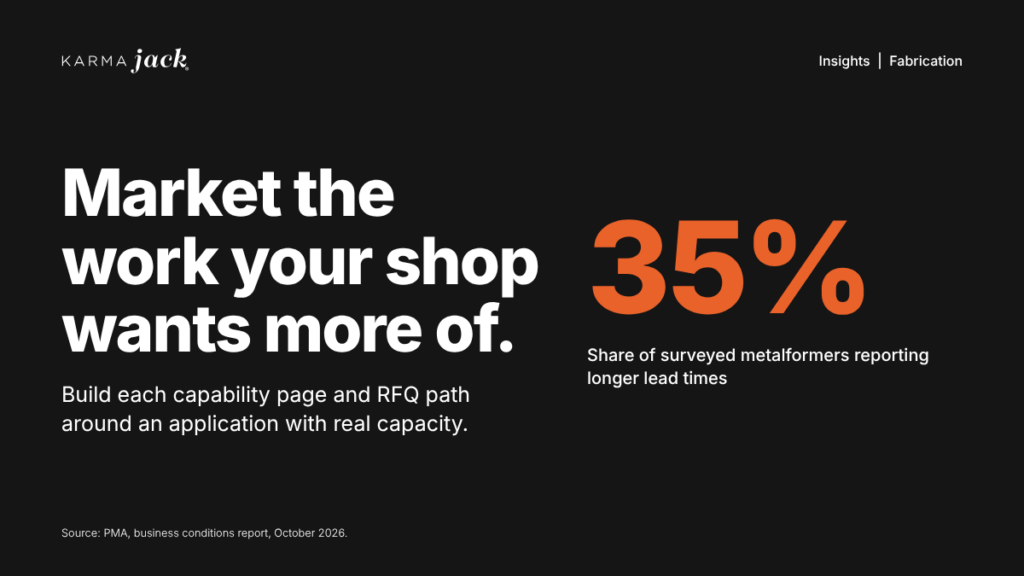
35%
Of surveyed metalformers reported longer lead times
Source: PMA, October 22, 2026. Survey of 80 U.S. and Canadian metalforming companies; not all fabrication businesses. [1]
Separately, NAM’s Q3 survey found manufacturers expecting input costs to rise 5% over the next year. These are expectations. They do not measure metal-price inflation or prove your costs, capacity or delivery performance. [2]
Use that context to make scope and timing clearer. Review recent RFQs with sales and operations. Identify the applications that fit your processes, quantities, freight economics and available capacity. Record the requests you repeatedly reject and why.
A useful first campaign may concern a finished assembly or a specific production process. “Metal fabrication” alone tells you little about whether a visitor needs one replacement bracket, an industrial production program or equipment to open a shop.
Replace the equipment list with a buyer’s evaluation page
Choose one desired application and show how the work moves from drawing review through the required manufacturing stages. Explain which processes are performed directly and which involve partners.
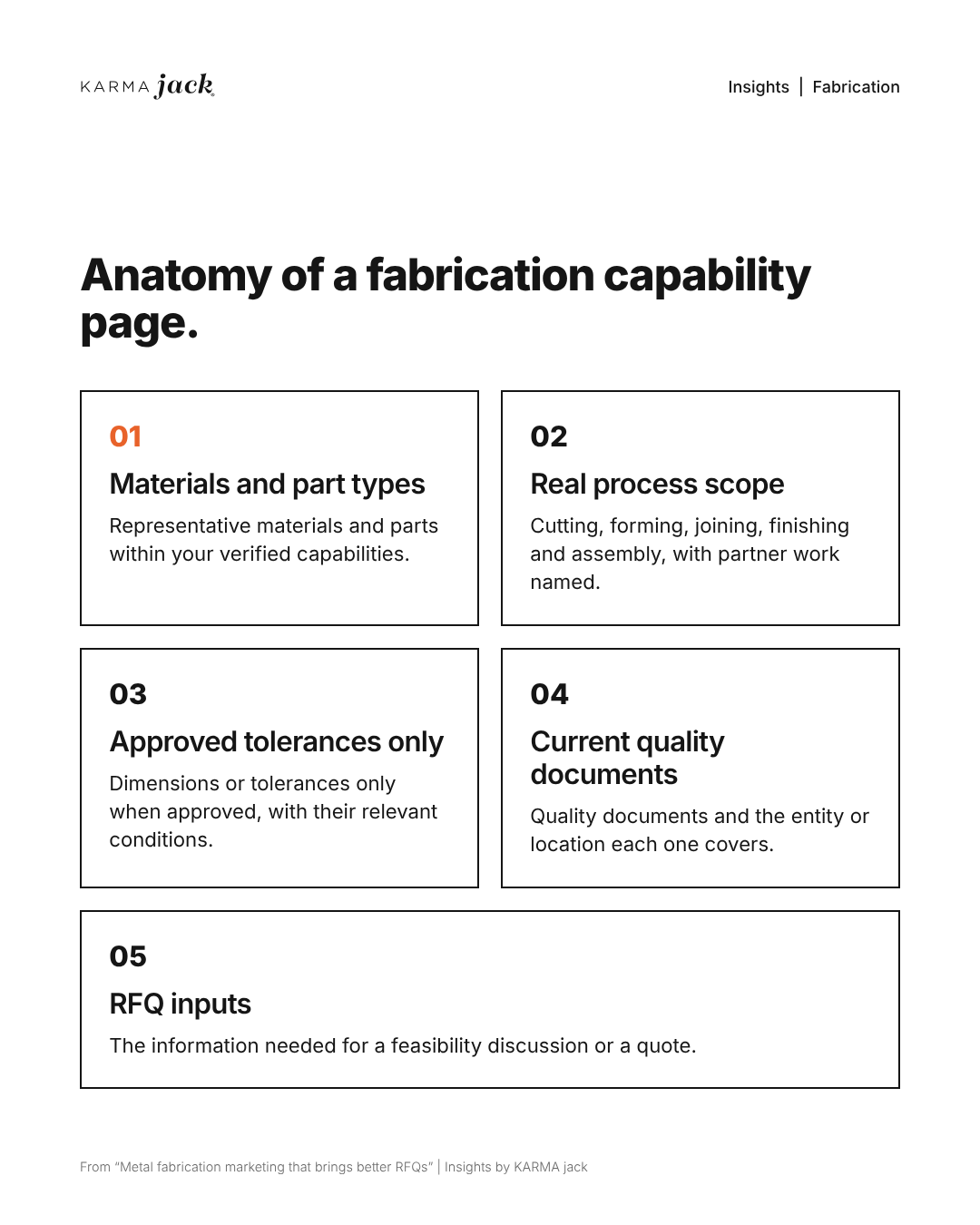
For a proposed production-assembly page, include:
- Representative materials and part types within your verified capabilities.
- The actual cutting, forming, joining, finishing and assembly scope.
- Dimensions or tolerances only when approved, with relevant conditions.
- Current quality documents and the entity/location they cover.
- The information needed for an initial feasibility discussion or RFQ.
- Use approved photographs of real work. A short caption explaining the part’s function, process sequence or inspection consideration is more useful than a generic factory image.
- Keep customer identities, drawings and distinctive parts private unless their public use is approved. If a case study is cleared, explain the requirement, process choice and supplied scope. Use outcome numbers only with their period, comparison and evidence.
Build search content around the questions before a quote
Ask your sales and engineering teams which questions come up before a buyer sends a drawing. Those questions can become useful articles linked to the relevant capability page.
Proposed examples include “What to include in a production metal-fabrication RFQ” and “How finish and assembly requirements affect a fabrication brief.” Explain the information your team needs and why. Avoid giving a universal tolerance, lead time or cost-saving claim.
Illustrative search themes might combine a real process with a desired industrial application, such as production tube fabrication or finished metal assemblies. Validate the terms and demand.
Do not create a page for every material/process combination unless your business can support it with substantive, distinct information.
Keep one clear preferred URL for each capability. If old brochures, duplicate service pages and campaign copies compete to describe the same offer, ask the web team to assess canonical URLs (the preferred version of a page) and redirects.
Google’s guidance describes these as signals for duplicate or very similar pages. Each site needs its own implementation. A blanket redirect rule will not fit. [3]
Make your technical proof useful to AI-assisted buyers
A buyer may ask an AI system, “What information does a fabricator need to quote a welded assembly?” Publish an answer that identifies the drawing revision, material, quantities, finish, relevant tolerances, inspection requirements and delivery context.
Explain which details can wait until a feasibility conversation.
Put the essential answer on the page, with descriptive links to supporting resources. A capability claim should be traceable to current information. Do not use an AI tool to invent ranges, certifications or experience to fill gaps in the copy.
Ask your web team to verify the priority pages:
- Search crawlers can access the relevant content.
- Structured data (schema markup) agrees with what visitors can see.
- The site uses accurate technical content and a coherent structure; Google requires no special AI schema. [4]
- Where available, use the Search Console generative-AI performance report to see which pages gain visibility in those features. [5] Keep that separate from analytics and CRM outcomes. An impression measures visibility. Track visits, accepted RFQs and orders separately.
Make the RFQ route easier without exposing drawings
Give a buyer a short initial route that captures application, company contact, quantity context and project stage. Carry the originating capability page into the sales record.
Provide a company-approved secure exchange for drawings and other confidential files. Explain the process plainly. Do not promise confidentiality or security features your business has not verified.
Test the RFQ path before increasing promotion:
- Make the checklist available so buyers can prepare.
- Complete the inquiry on mobile and confirm the application context reaches sales.
- Name the routing owner and record repeated missing-information requests to improve the page.
Promote the capability with a focused test
For search advertising, keep the selected application and its landing page aligned. Review terms with sales for consumer one-off work, jobs, equipment sales and other actual mismatches. Do not spend on services without suitable capacity or viable economics.
Give sales the same page, checklist and approved process visuals for existing-account development. An account-focused campaign can introduce that capability to a defined group of relevant manufacturers, using approved audience data and available platform targeting.
Keep the message concrete: what the buyer can evaluate, what proof is available and what the next conversation will establish.
Measure accepted work, then improve the route
Track inquiries, accepted RFQs, quotations and won work separately. Review fit by application and source when attribution is available. Capture reasons such as unsuitable quantity, process mismatch, timing or freight constraints.
Before forecasting a traffic or conversion lift, establish a comparable baseline and confirm tracking. A change in raw lead count can reflect campaign spend, seasonality or poor-fit traffic.
The result that matters is whether the work advances toward suitable quoted and won opportunities.
Give the first capability campaign a clear operating test
Sales and operations should choose one application with usable capacity and acceptable commercial fit. An estimator identifies the information needed to assess it. Marketing turns those inputs into the capability page and RFQ checklist. Test the inquiry and approved drawing-transfer process before paying for traffic.
Use one RFQ record per buying project, with application, source, quantity profile, drawing status, acceptance decision, missing information and next step. Count a revised drawing against the existing RFQ. Do not log it as a new lead. Have the estimator record why an RFQ cannot advance.
Compare accepted RFQs with valid inquiries from the same intake period. Also count accepted RFQs that required another request for essential information. Those two measures help distinguish poor targeting from an incomplete briefing process. Follow quotes and wins later against the original group, allowing for the sales cycle.
If the wrong quantities dominate, clarify production fit on the page and in the campaign. If appropriate buyers repeatedly omit finish requirements, improve the checklist. If technically suitable work fails on capacity or freight economics, revisit the offer before increasing promotion. These are recommended diagnostic checks. They do not guarantee performance.
Metal fabrication RFQ FAQs
What information helps a fabricator assess a welded-assembly RFQ?
Identify the drawing revision, material, quantities, finish, relevant tolerances, inspection requirements and delivery context. Explain which details are needed for a quote and which can follow during feasibility review.
How should a fabrication page describe quality credentials?
Use current documents and identify the entity and location they cover. Publish dimensions or tolerances only when approved with their conditions, and distinguish direct work from partner processes.
What can repeated missing RFQ details tell us?
They may reveal a briefing gap. Track what estimators repeatedly request and improve the relevant checklist. Keep that separate from unsuitable quantities, capacity or freight economics, which may require a different offer or targeting decision.
Start with the production work you want
KARMA jack’s manufacturing services connect niche SEO, technical storytelling, website development and paid promotion. [6] Applying them to one desired capability gives your team a practical place to start and a clear outcome to evaluate.
Choose the production work you want more of. Build the page and RFQ path around it. Let’s talk strategy.

