
Lab and education furniture marketing should answer the questions your specialists explain every week. Turn those recurring questions into clear resources, connect them to the applications you actually serve and give buyers a direct route to qualified project support.
The goal is a better-informed inquiry: a planner, distributor or facilities team that understands your fit and knows what information to bring.
Choose the segment before choosing the campaign
Research laboratories, teaching labs and career-technical classrooms have different users, documentation needs and buying processes. Name the audiences your business serves and plan for each one separately.
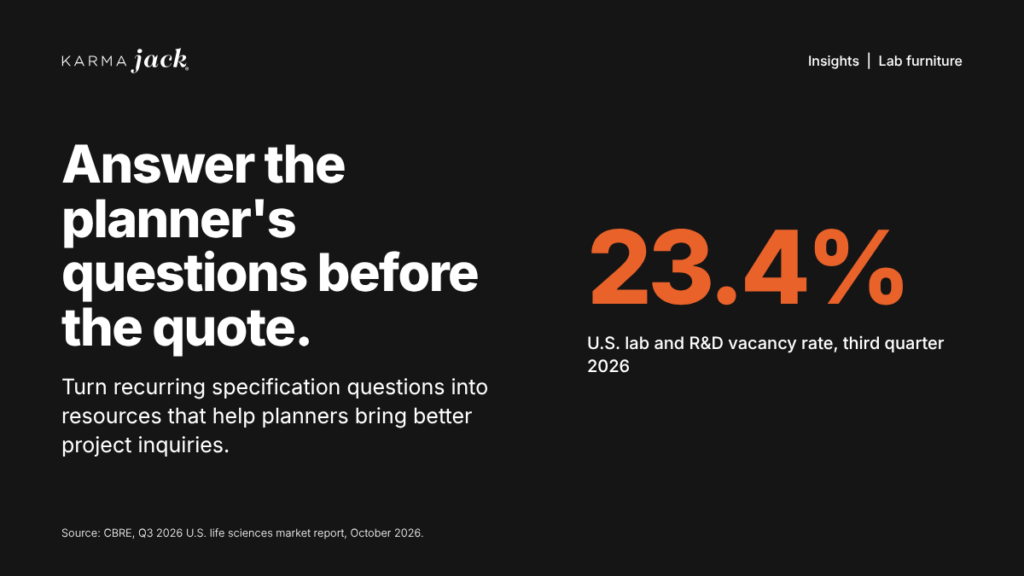
23.4%
U.S. lab and R&D vacancy in Q3 2026
Source: CBRE, October 29, 2026. Commercial-property data. It does not forecast furniture orders or education spending. [1]
The same report recorded 2.7 million square feet of leasing. Construction completions fell 44% year over year but more than doubled from the previous quarter. Use those property-market signals to ask which project types your business is actually seeing.
Use market context to frame better questions. Are your own opportunities coming from tenant improvements, relocations, renovations or new construction? Which applications reach quotation? Your sales and distributor records should decide which segment gets the first campaign.
Turn a recurring technical question into a useful resource
Bring a sales specialist and a technical reviewer into a working session. Identify questions that repeatedly delay a recommendation, specification or quote. Then choose one your team can answer with documented expertise.
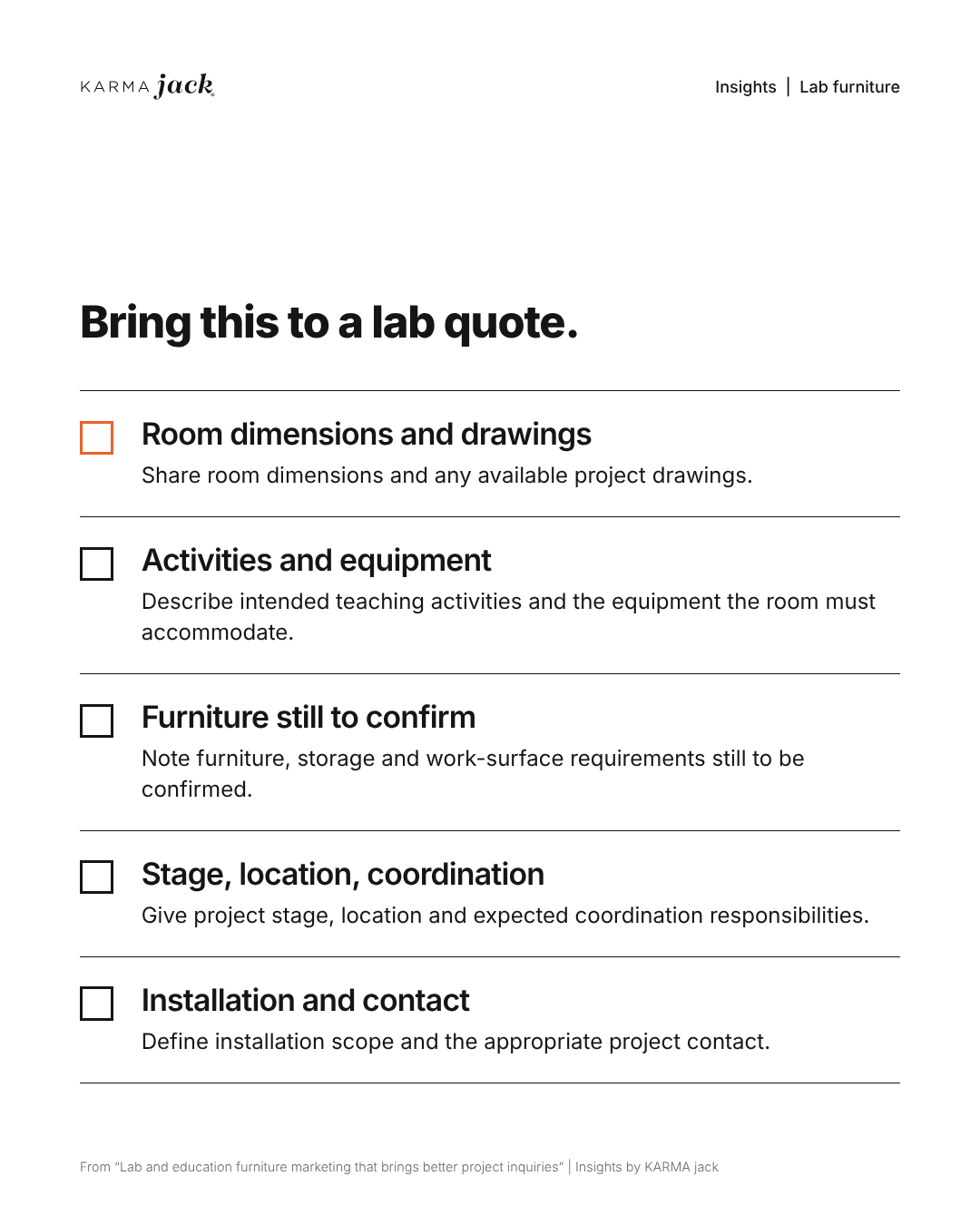
A proposed resource could be “What to collect before requesting a teaching-laboratory furniture quote.” Make it a practical checklist:
- Room dimensions and available project drawings.
- Intended teaching activities and equipment to accommodate.
- Furniture, storage and work-surface requirements still to be confirmed.
- Project stage, location and expected coordination responsibilities.
- Installation scope and the appropriate project contact.
Separate initial-discussion information from what is required for a formal quotation. Give an early-stage planner a way to ask for help and treat missing details as a reason to follow up.
A materials comparison can also be useful, but it must use current product documentation and state test conditions and limitations. Chemical compatibility, fume-hood selection, ventilation, accessibility and compliance require qualified project-specific review. Marketing should help people reach that review.
Build a technical library people can actually navigate
Create a focused application page that connects the planning question to suitable product families, current drawings and the right specialist. Keep the essential dimensions, product scope and document descriptions in page text. Give downloads clear names and revision dates.
For example, a teaching-lab page could link to an approved planning checklist, relevant casework options (built-in cabinets, storage and work surfaces), a completed-project explanation and a project inquiry. A research-lab page can organize the different documentation its audience needs.
These structures are examples. Adapt them to your own products and documents.
Microsoft recommends making important information available as web-page text (HTML) while retaining useful supporting files; text PDFs can also be indexed. [2] A scanned catalog alone can leave both a buyer and a search system with little accessible context.
Give every technical page an owner and a maintenance check:
- Update the page, linked file and relevant comparison together when a specification changes.
- Describe the responsible technical review accurately.
- Show an approval date only when a real review took place.
Make AI-search preparation an evidence task
Think about a specific buyer question an AI assistant might summarize, such as “What documents should a school prepare for a lab casework quote?” Write a direct, complete answer, then explain the relevant details and limits. Link the current supporting document.
Do not publish dozens of lightly rewritten versions of the same answer.
Have your web team verify that priority pages can be indexed, that important information renders on mobile and that legitimate crawlers are not inadvertently blocked. Review Google’s current AI-inclusion setting deliberately with the site owner.
A June 2026 announcement, updated in August, introduced a control covering Google’s generative-AI search features. [3]
Keep confidential research, facility plans and customer drawings behind the appropriate access controls. Robots directives only guide search crawlers. Use logins and permissions to control who can open a file.
If a public PDF needs search restrictions, the web team should assess the supported HTTP-header controls and confirm the intended result. [4]
Give paid search a narrow assignment
A proposed initial campaign could target teaching-laboratory furniture within the territory you can serve. Illustrative query themes include “teaching laboratory furniture supplier” and “school science lab casework.” Validate volume, costs and actual search wording before choosing them.
The landing page should explain the supplied product scope, project support, installation boundaries and next step. Review search terms for unrelated laboratory instruments, DIY work and services outside your capabilities.
Give distributors a version of the same resource they can use in an active conversation. For a permitted email program, a project-information checklist can support a meaningful follow-up.
Verify customers’ real planning cycles before assuming that every institution follows the same budget or construction calendar.
Qualify the project and measure the handoff
Keep the initial form practical: organization, application, project location, stage and a short description. Carry the originating resource into the sales record. Offer an approved process for sharing drawings after contact is established.
Track the handoff through three practical stages:
- Accepted inquiries, with territory and distributor routing recorded.
- Technical consultations and quotations, keeping duplicate handoffs out of the count.
- Opportunities, with valid early-stage projects retained for appropriate nurture.
Use search visibility and content engagement to diagnose interest, then use sales outcomes to judge relevance. A campaign bringing the wrong facility type needs different work from one attracting the right buyers before their specifications are ready.
Test a teaching-lab resource before expanding it
For a first pilot, choose one teaching-lab application your business can support. The product specialist checks the current documents, the distributor or sales lead confirms territory routing, and marketing connects the planning checklist to a short inquiry. Qualified specialists retain responsibility for project-specific safety and compliance decisions.
Ask a person outside the product team to locate the current planning document, identify the supplied scope and submit a test inquiry. Confirm that project location, stage and resource name reach the responsible person. A working download is only the first check.
Keep one record per project across manufacturer and distributor contacts. Record facility type, territory, stage, routing owner, missing information and next step. Separate early planning from quote-ready work so a legitimate future project stays in the pipeline while its specification develops.
Review accepted inquiries, completed specialist handoffs and quotations for the same intake group. If territory mismatches recur, improve routing. If planners repeatedly lack room information, clarify what is needed now and what can follow. If the campaign attracts equipment buyers outside your furniture scope, adjust targeting. These are suggested operating checks. They do not forecast orders.
Lab furniture planning FAQs
What should a teaching-lab furniture planning checklist include?
Ask for room dimensions and drawings, teaching activities, equipment, furniture needs, project stage, location, installation scope and a contact. Explain which details are needed now and which can follow during technical review.
Can a marketing comparison confirm that a lab material is safe for a project?
No. Use current product documentation with its test conditions and limits. Chemical compatibility, ventilation, fume-hood selection, accessibility and compliance need qualified project-specific review.
How should manufacturers and distributors count the same lab project?
Maintain one project record across the handoffs, with facility type, territory, stage, routing owner and next step. Track early planning separately from quote-ready work and follow accepted inquiries through specialist review and quotation.
Start with one useful planning resource
KARMA jack’s advertising services and website design can connect targeted campaigns, relevant landing pages and a measurable inquiry route. [5] For this sector, source verification and technical review belong inside that work from the start.
Choose one segment, one recurring question and one next step. Build a resource that a planner would keep, then follow what happens when the right buyers use it. Let’s talk strategy.

