
If you sell industrial automation, your strongest marketing asset may be an application your engineers can explain clearly. Show the operation, the integration questions and the evidence a buyer needs for the next decision. Then connect that explanation to focused search, technical video and a project inquiry.
A plant engineer evaluating a retrofit, an operations leader planning a new cell and a purchasing team comparing suppliers should be able to find the information relevant to their role.
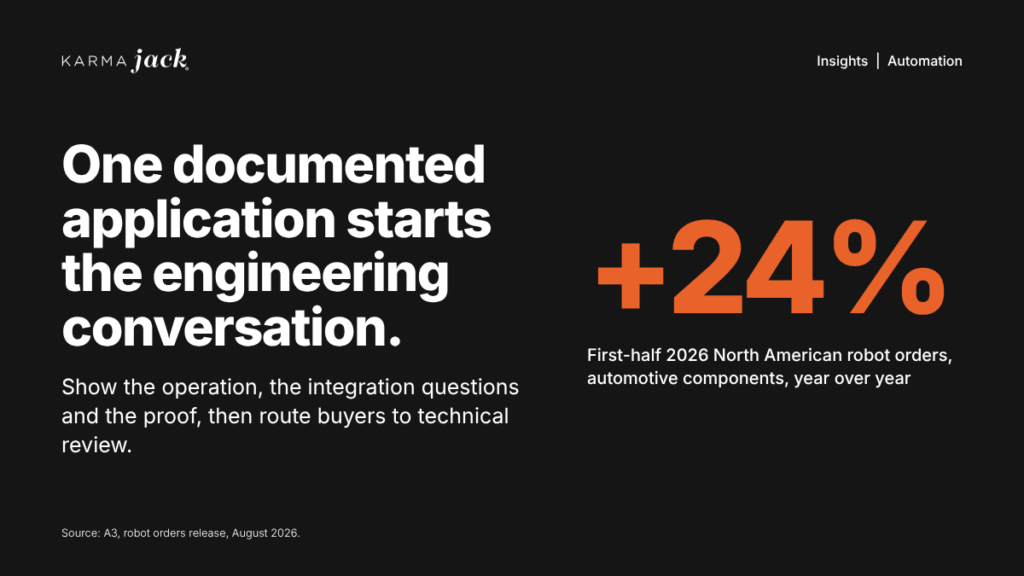
Separate demand by application and buyer
+24% / −25%
Automotive components / Automotive OEMs
First-half 2026 North American robot orders, year over year. Source: A3, August 11, 2026. Covers robot orders only. Custom automation and feeding equipment sit outside this count. [1]
Total North American robot orders rose 2% in units and 6.6% in order value in the first half of 2026. The sharp difference between automotive segments shows why a broad automation-growth claim is a weak targeting instruction.
These first-half figures are a historical comparison, not the latest quarter. A3’s October 28, 2026 release reported that Q3 robot orders rose 90.4% for automotive components and 7.5% for automotive OEMs, year over year. Total North American unit orders rose 24.8% in Q3. These remain robot-order measures, not a measure of all custom-automation or feeding-equipment demand.
Use the market signal to investigate your own opportunity mix. Which industries are requesting reviews? Which operations match your capabilities? Which projects reach a proposal? Choose a segment and application from that evidence.
Create separate routes for retrofits, standard equipment and new custom systems. Each needs different intake information and different proof.
Build an application page an engineer can use
Start with the operation: feeding, placement, assembly, inspection or another verified capability. Describe the input, the required output and the project conditions that affect fit.
For a proposed component-placement page, useful sections might include:
- The component and operation types the team can assess.
- Existing-equipment interfaces relevant to a retrofit.
- Questions about feeding, part variation, verification and maintenance.
- An approved demonstration with its setup and limitations.
- The information required for a technical review.
- Explain the actual scope your business can own. Distinguish equipment supply, integration, commissioning and ongoing support. Have a technical reviewer approve any compatibility, cycle-time, detection or serviceability assertion.
- Machine safety, guarding and compliance remain specific engineering responsibilities. A video or a marketing comparison does not establish that a customer’s installation is safe.
Make technical video discoverable and worth watching
- Plan the demonstration around the buyer’s question. Show the complete operation, identify the setup and explain what the viewer should notice. Add accurate captions and a written summary so the meaning survives when the sound is off.
- If video search is an objective, create a focused watch page where one useful demonstration is the main content. Google’s video guidance distinguishes that from a product page where a clip is only supplementary.
- Indexing the page does not automatically index its video. [2]
Give the demonstration a practical search-readiness check:
- Use a specific title and a stable thumbnail.
- Have the web team validate supported video metadata.
- Review Search Console’s video indexing information; passing a metadata test does not promise a video result.
- A proposed title such as “Component placement retrofit: integration questions and demonstration” tells an engineer more than “See our innovation.” Link the watch page to the application page and the project-inquiry route.
- Reuse a concise approved cut in sales follow-up and an integrator presentation.
Answer the questions behind AI-assisted research
- A useful topic might be “What information does an automation integrator need to assess a retrofit?” Answer it with the operation, existing equipment, interfaces, part information, quality requirements and project constraints your team actually reviews.
- Add a clear comparison only where you have expertise: for example, the assessment questions that differ between modifying an existing cell and building a new one. State assumptions. Avoid generic payback tables based on invented labor savings or operating hours.
- Publish the important explanation as accessible text, with links to the relevant technical evidence. Keep public descriptions separate from confidential drawings, customer layouts and proprietary control information.
- In June 2026, Bing Webmaster Tools added preview AI visibility reports: intents, topics, citation share and period comparisons. A grounding query is the search an AI assistant runs to find sources for its answer.
- Citation share is the percentage of citations your site receives for a grounding query. It does not measure traffic or quality. [3] If the report is available for your site, inspect whether the themes match the applications you want to sell.
- Treat broad AI classifications cautiously in a specialized field. Bing notes some labels may still be broad for niche domains.
- Use those observations to improve a useful answer page. Skip the large volumes of thin articles around every suggested phrase.
Put a narrow campaign behind the proof
- Choose an application-specific search theme, such as an automation retrofit for a defined operation. Validate demand and cost before launch. Keep broad “automation” traffic separate because it can include software, home automation and other unrelated intent.
- Review search terms with sales and add exclusions for actual mismatches. Send the ad to the application page or demonstration that answers the query. Let the page clarify what needs a technical review before a quote.
- For account-focused campaigns, select a sales-approved sector and buying role. An engineering audience may value integration details. Operations may need a clear explanation of the production problem and implementation considerations.
- Give each audience evidence that answers its own questions.
- In permitted trade-show or existing-account follow-up, send the exact demonstration relevant to the conversation. Ask for the next missing project input. This gives sales a concrete reason to reconnect.
Measure technical progress through the pipeline
- Define a qualified technical review before optimizing for forms. Record application fit, industry, retrofit versus new-system status and a viable project next step. Unknown details should remain unknown until confirmed.
Follow the technical pipeline:
- Reviews accepted and proposals requested.
- Quotations issued and projects won.
- Rejection reasons that reveal application or targeting mismatches, even when advertising metrics look healthy.
- For an economic estimate, use the customer’s verified operating conditions and implementation costs. Label scenarios separately from measured results and explain the timeframe. No industry report supplies a universal payback percentage for your systems.
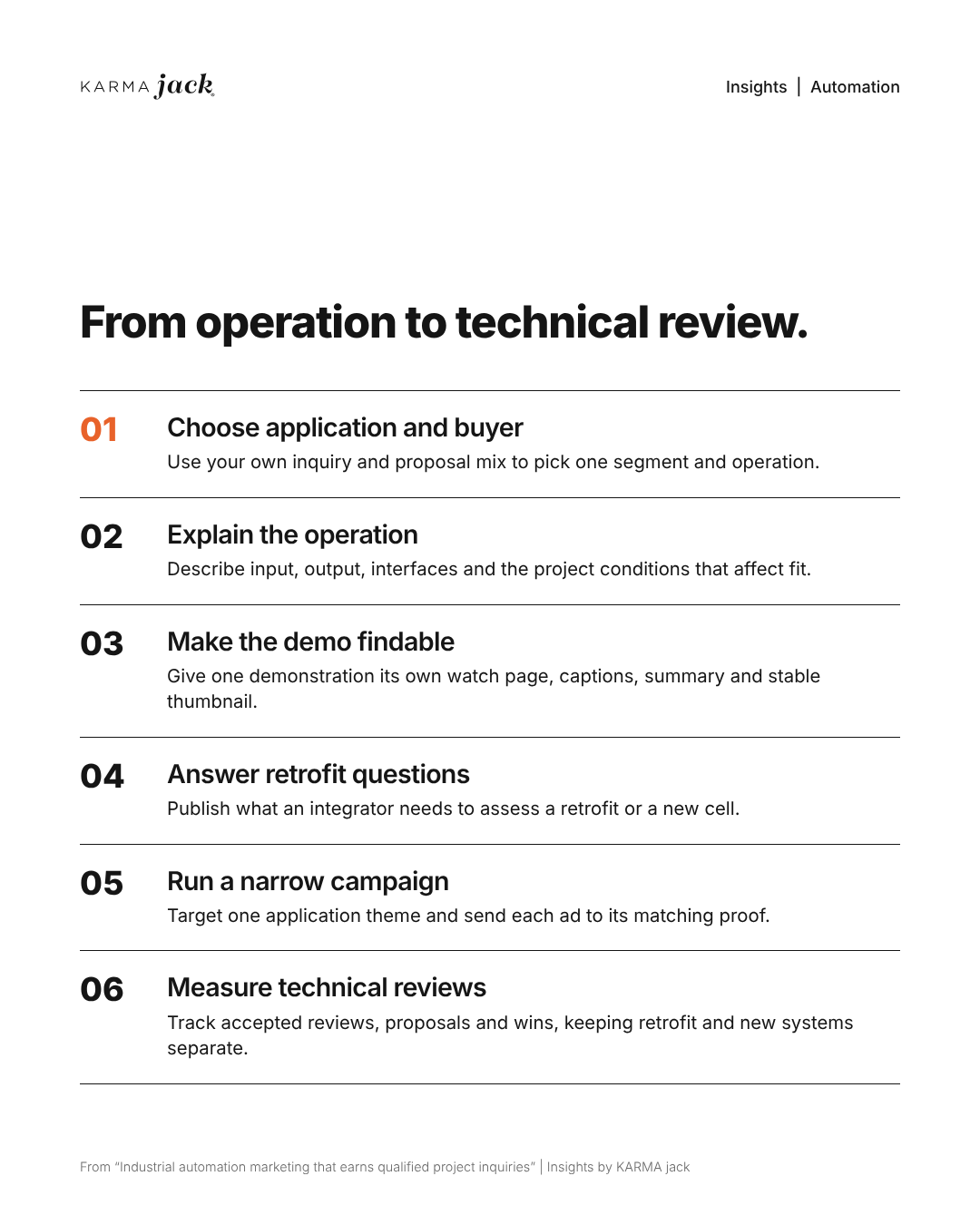
Build a pilot around one technical decision
Let the engineering lead choose a documented operation and approve the demonstration conditions. Sales defines the project types worth reviewing. Marketing connects the application page, demonstration and inquiry. A test submission should show whether the retrofit or new-system context reaches the correct technical reviewer.
Keep one record per project: application, industry, existing or new equipment, known interfaces, review status, missing input and next step. Keep unknowns explicit. Several contacts or repeated form submissions about the same cell should not become several opportunities.
Review the first inquiries with engineering. Unsupported part variation suggests a fit or targeting problem. Repeated requests for the same interface detail suggest missing page content. Suitable reviews that never reach a proposal may need a scope or commercial discussion before any increase in advertising.
Measure accepted technical reviews divided by valid project inquiries from the same intake period. Track proposals and wins against those projects as they mature. Keep retrofit and new-system results separate when their effort and sales cycles differ. This proposed pilot tests whether marketing starts useful engineering conversations. It makes no prediction about equipment performance or payback.
KARMA jack connects technical storytelling, niche SEO, conversion-focused web design and paid media within a discovery-to-measurement process. [4] For an automation supplier, one strong application and its evidence can give that process a clear starting point.
Industrial automation marketing questions
Can an automation demonstration establish that a customer’s installation is safe?
No. Identify the demonstrated setup, scope and limits. Machine safety, guarding and compliance require project-specific engineering review, and technical claims need approval for their actual conditions.
Does indexing a product page mean its demonstration video is indexed?
No. Page and video indexing are separate. If video search matters, use a focused watch page, supported metadata and a stable thumbnail, then check the actual indexing result without promising placement.
What should count as a qualified automation inquiry?
Agree on application fit, industry, retrofit or new-system context and a viable technical next step. Keep unknowns explicit and follow accepted reviews, proposals and wins separately as the project matures.
Choose the operation you want to grow. Make the engineering conversation easier to begin. Let’s talk strategy.

