
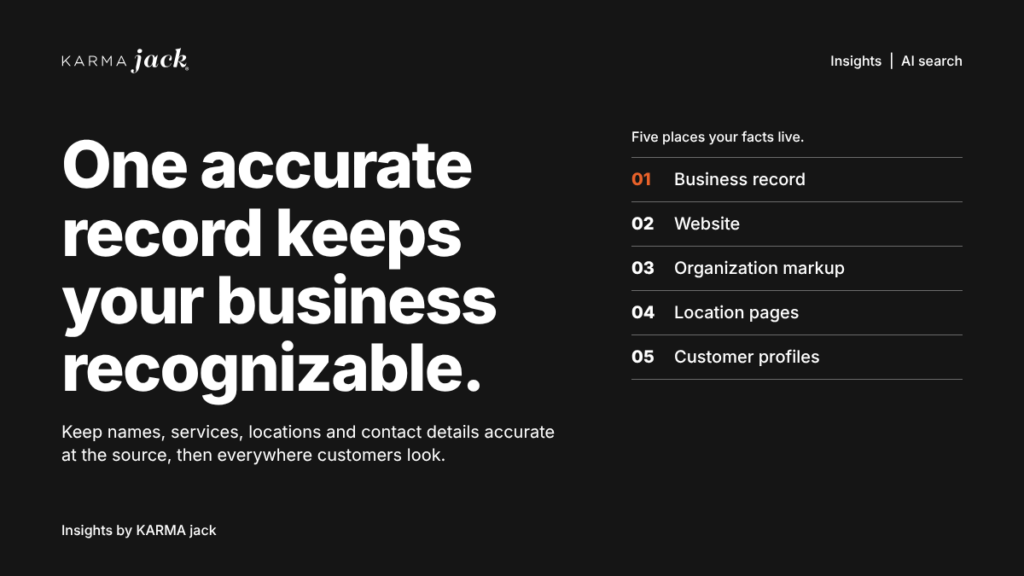
Brand entity optimization helps customers and search systems identify the right business. Maintain a reliable business record, describe verified facts in Organization structured data, align official profiles and coordinate changes to names, locations and phone numbers.
For customers, ambiguity creates friction. They may find the wrong branch, call an old number or misunderstand what a company offers. For search systems, accurate structured information can help distinguish one organization from another. [1]
Start with the facts your customers need, then make those facts easier to maintain.
Create one reliable business record
Keep a controlled public business record with these fields:
- Business name
- Official website
- Customer-facing phone numbers
- Operating locations
- Hours
- Core services
- Owner
- Date checked
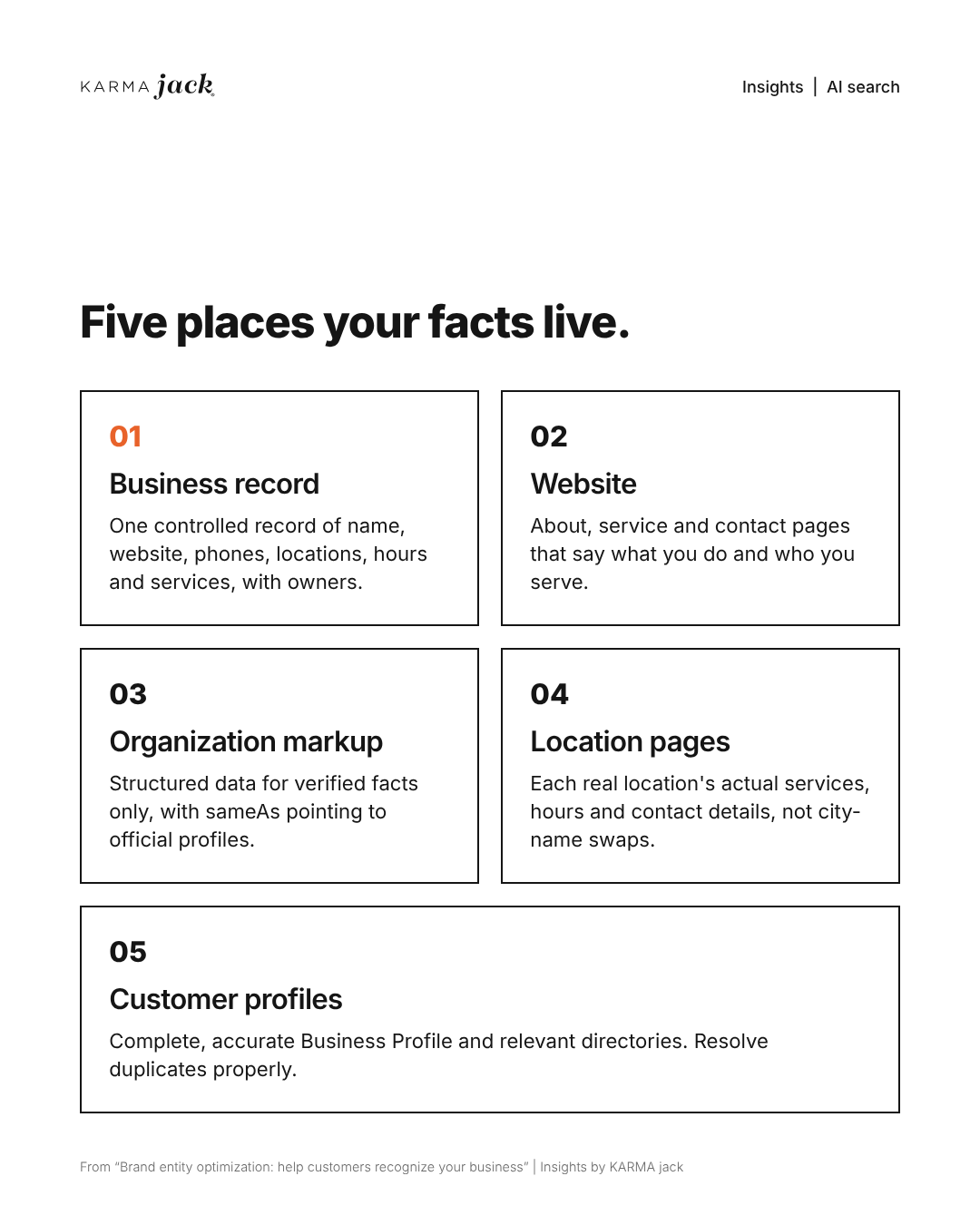
Use that record when updating the website and approved profiles. Consistency means the information agrees in substance. It does not mean every platform needs an identical paragraph or the same punctuation.
Be precise about brand names, legal names and trading names. If customers see more than one name, explain the relationship where relevant. Do not add promotional keywords to a business name just because you hope they will improve visibility.
Make the website explain the business
A useful About page tells people what the organization does, who it serves and how it operates. Service pages add the detail a buyer needs. Contact information should be easy to find and correct.
For people offering specialized advice, publish accurate biographies and credentials. Link to relevant professional information where appropriate. Do not invent a reviewer, award or certification to make a page look authoritative.
If a business has changed ownership, moved or retired a service, review the pages affected by that change. A new homepage sentence does not correct an old location page or downloadable guide.
Does Organization schema get me a knowledge panel?
Google says Organization structured data can help it understand and disambiguate an organization. Its documentation supports properties such as name, URL, logo and sameAs links to other pages about the organization. [1]
- name: The verified organization name.
- url: The official website URL.
- logo: The organization’s actual logo.
- sameAs: Official profiles or other pages that identify the same organization.
The practical instruction is to mark up verified information already supported by the website. Use official profiles for sameAs, not a collection of loosely related pages. Check whether your CMS already generates organization markup before adding another copy.
Structured data labels business facts in a format a search system can read. For example, name identifies the organization and sameAs points to an official profile about it. These labels help describe the business; they do not guarantee a knowledge panel, ranking or AI recommendation.
Have someone responsible for the website validate the implementation and review it after business details change.
Give each real location its own accurate information
For a multi-location brand, a visitor should be able to tell which services a specific location offers and how to reach it. A location page should reflect that location’s actual details rather than a city-name swap in generic copy.
Keep the parent brand relationship clear. Where appropriate, explain which website or profile represents the local operation and which represents the wider organization. Use the most specific applicable structured-data type and truthful relationships.
Do not present a service area as a staffed office. If customers cannot visit an address, follow the relevant platform’s rules for displaying it. A more impressive-looking footprint is not worth sending someone to the wrong place.
Maintain the profiles customers actually use
Google advises businesses to keep Business Profile information complete and accurate. Its local ranking guidance describes relevance, distance and prominence as major considerations. Complete information can help, but there is no way to request or pay for a better local ranking. [2]
Prioritize the profiles and directories relevant to your market. Check hours, categories, location links and contact details. Resolve duplicates through the platform’s appropriate process rather than creating new listings whenever an old one is inconvenient.
Do I need a Wikipedia page?
There is no need to pursue a Wikipedia page as a routine SEO checklist item. Reference projects have their own eligibility and editorial rules. Focus first on accurate sources your customers already use.
How do I update my business phone number everywhere?
A location opening, rebrand or phone-system change should trigger a coordinated update. Give one person responsibility for tracking the change across the website, profiles and customer-facing documents.
For a phone-number change, use this checklist:
- Confirm the approved new number, the affected locations and the date it should take effect.
- Update the source record, contact and location pages, applicable structured data and approved profiles.
- Check ads, downloadable guides and other customer-facing materials that still carry the old number.
- Place a test call and test the mobile tap-to-call link. Record who checked them and when.
- Log any third-party listing awaiting correction, its owner and the next review date. Search for the old number again after the updates.
That routine is easier to maintain than repairing years of contradictory information at once.
Common questions about brand entities
Will consistent details guarantee an AI recommendation?
No. Accurate information reduces avoidable confusion, but it does not control the response a platform generates.
Does every location need identical copy?
No. Shared brand facts should agree. Local pages should explain the differences that actually matter to customers, including services, hours and contact details.
Should a business add promotional keywords to its name?
Use the verified business name. Do not add promotional keywords just to seek more visibility. Where customers encounter different legal or trading names, explain the relationship when relevant.
Should we add Organization markup if the CMS already supplies it?
Inspect the existing output first. Validate verified business facts and official profile links rather than adding another potentially conflicting copy. Review the markup again when business details change.
Can a service area be presented as a staffed location?
No. Describe actual operations and follow the platform’s address-display rules. A location page should help customers reach the right service, not suggest an office they cannot visit.
Make the right business easier to choose
Start with the information most likely to affect a customer today. Correct it at the source, update the places people find it and assign someone to keep it current.
KARMA jack’s local SEO and website work can help connect these records to the pages and profiles customers use. Start with one important location or an upcoming business change, then map the facts that need to stay aligned. [3]
Sources
[1] Google Search Central: Organization structured data
[2] Google Business Profile: Tips to improve your local ranking

