AI search for HVAC companies starts with useful service information, accurate local details and a working inquiry path. Choose one service your team can deliver and make the homeowner’s next step clear.
AI search visibility begins with useful information: the services you offer, the communities you serve and a clear path to getting help. Nobody can promise that an AI answer will name your business. You can improve the information available when people and search systems evaluate it.
For HVAC owners and marketing leaders, the first priority is a high-value service page connected to accurate local information and a working inquiry path. Improve that path before paying for broad AI visibility claims. Track where suitable homeowners drop out between finding the page and completing a job.
Start with the information a homeowner needs
Open your most important service page on a phone. Can a new visitor quickly tell whether you handle their problem and serve their area?
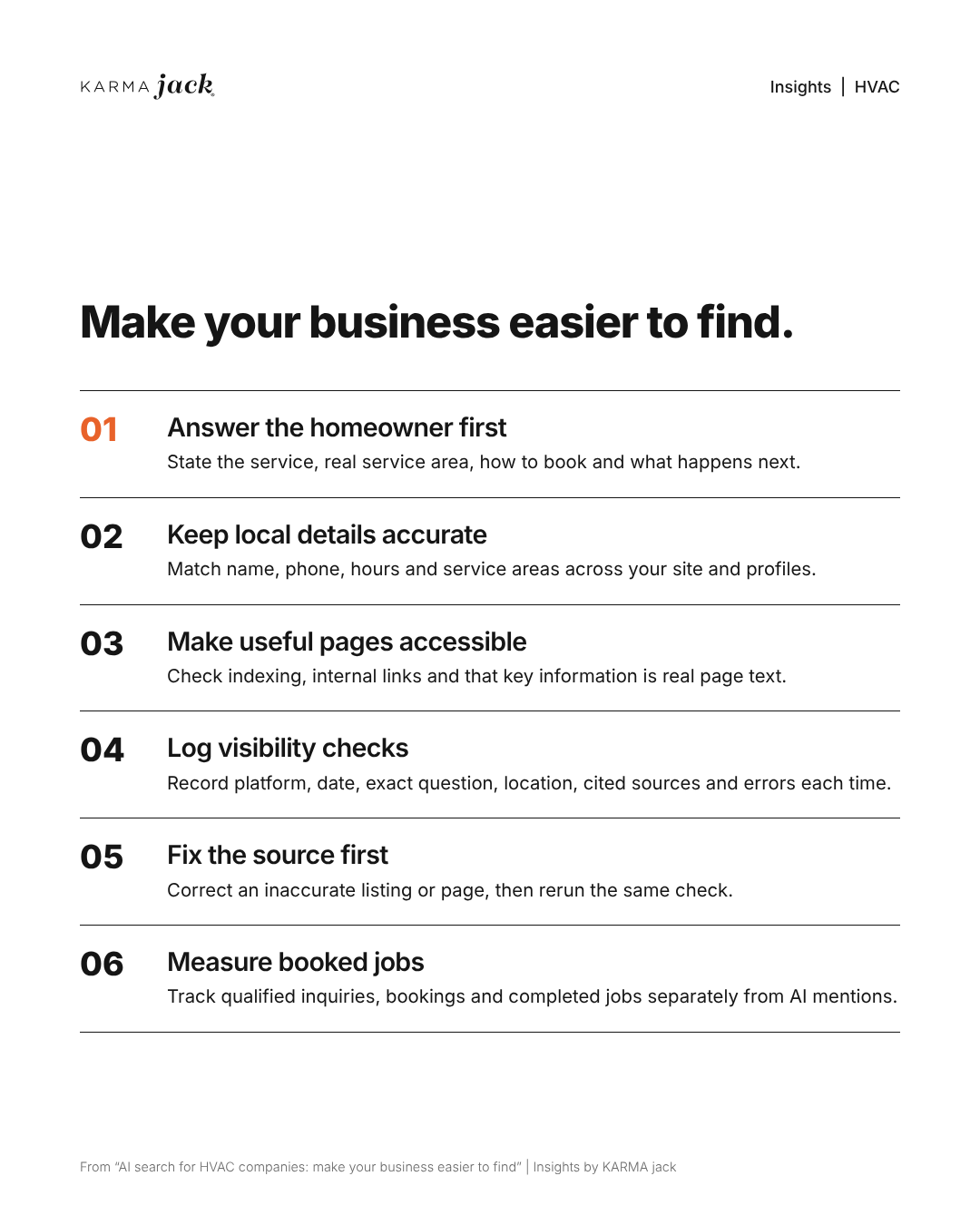
An AC repair page should explain the service, the actual service area, how to request an appointment and what happens next. If after-hours service has limits, state them. If an estimate requires an inspection, say so. Do not let a chatbot or a search snippet be the first place a customer learns that a service is unavailable.
Use language customers recognize. A page can answer “Why is my AC running but not cooling?” without pretending to diagnose the equipment remotely. Explain the next sensible step and when a licensed technician needs to assess it.
Build one service page around a decision
Ask the owner, dispatcher and website editor to choose a service with business value and available capacity. AC repair and replacement estimates answer different questions. A repair visitor needs service coverage and an honest way to request help. A replacement visitor needs to understand the assessment process and what information will support an estimate.
For the chosen page, collect the actual service scope, equipment limitations, service area, scheduling route and approved fees or offer terms. Put the immediate answer near the top. Follow it with what happens during the visit, what requires an on-site assessment and the next step. Use genuine, permission-cleared project evidence only when it supports the decision; an invented example is not proof.
Have dispatch check whether the page’s appointment promise matches the current workflow. Have a qualified technical reviewer check equipment statements. The editor should link from related service pages, test the phone button and form on mobile, and remove contradictory information from maintained profiles.
Keep local business information accurate
Google describes relevance, distance and popularity as important parts of local ranking. Complete business information and genuine customer reviews can help. That guidance concerns Google local results; it does not establish one ranking formula for every AI assistant.
Check your business name, phone number, hours, service areas and website across your website and major business profiles. Correct contradictory information. Service-area businesses should follow each platform’s address rules rather than publish a private address just to make every listing look identical.
Read Google’s local ranking guidance before treating any profile tactic as a shortcut.
Make useful pages accessible
Your best answer cannot help visitors if it is buried in an image or blocked from search.
Ask your website team to check indexing, internal links and whether important information is available as readable page text. Keep related services easy to navigate. Explain your business using visible, factual content before adding technical markup.
Google’s guidance for AI features says established SEO practices still apply. It does not require a special AI schema or an extra machine-readable file to appear in AI Overviews or AI Mode. Eligibility still does not guarantee inclusion.
Use the search audit to choose an action
Ask the web team to inspect the chosen URL in Search Console. Check whether Google can access and index the intended page, whether the correct canonical is selected and whether important service text is available in the rendered page. Record the specific issue and owner. Do not add an AI file or special schema before diagnosing a real access or content problem.
Then follow the visitor’s path. If relevant traffic reaches the page but inquiries are mostly outside the service area, make coverage clearer and review targeting. If qualified inquiries arrive but bookings stall, investigate available appointments and callback handling. If bookings grow while completed jobs do not, check cancellations and job fit.
Keep separate counts for:
- Calls clicked
- Calls received
- Qualified inquiries
- Confirmed bookings
- Completed jobs
Deduplicate the same request across channels where your systems permit it. Google includes AI-feature activity in overall web reporting and also provides a dedicated Generative AI performance report for AI Overviews and AI Mode impressions. Impressions are not clicks, qualified inquiries or revenue.
Review the page and visibility log together after a defined observation period. Choose the next correction from the evidence. This is a practical testing sequence, not a promised traffic lift, ranking gain or number of jobs.
Create a small set of questions that reflect real buying decisions: emergency service availability, a specific repair, or choosing a contractor in a community you serve.
Use one repeatable AI visibility log
Keep one row per question and check, with these fields:
For example, test “Who repairs central air conditioners in [a city you actually serve]?” and save the exact answer. If it cites outdated hours, correct the underlying page or profile and keep the original observation for comparison.
- Platform
- Exact prompt
- Location context
- Date
- Answer
- Cited URL
- Factual error
- Correction owner
- Next review date
- Start with three fixed questions: who offers the service in your actual area, how to request that service and whether after-hours help is available. Reuse the same wording and location context at the next check.
- Fix an inaccurate source first. If a listing has old hours, update the listing and website through your normal approval process. Then rerun the check and record whether the answer changed. Do not describe a few successful checks as a market-wide visibility score.
Treat the results as observations. Responses can vary, and a handful of prompts cannot measure every homeowner’s experience. Pair that research with website inquiries, qualified calls and booked jobs. An appearance in an answer is not proof of a sale.
Give the next visitor a better answer
Start with one high-value service page and one business profile. Fix the gaps a homeowner would notice first. Then expand to the rest of your service information.
KARMA jack helps HVAC companies connect their marketing to the decisions customers make. Talk with our team about where clearer information and stronger search fundamentals could help your business.
Questions HVAC owners ask
Does AEO replace SEO?
No. Answer engine optimization describes making information useful in answer-based search experiences. Crawlable pages, clear content and accurate business information still matter.
Will adding FAQs get my company recommended by AI?
No format guarantees a recommendation. Add questions when the answers help a customer, and keep them specific to services you actually provide.
What should I measure first?
Start with qualified inquiries and booked jobs, alongside search performance and a documented set of visibility checks. Keep business outcomes separate from mentions.
What should dispatch verify on an HVAC service page?
Check the actual service scope, area, scheduling route and appointment promise against current operations. Have a qualified reviewer check equipment statements, then test the phone button and form on mobile.
Should a service-area business publish a private address for consistency?
Follow each platform’s address rules. Accurate business identity and service coverage matter, but making listings look identical is not a reason to publish a private address or imply a staffed office.
What if relevant traffic arrives but bookings stall?
Separate inquiry fit from intake and capacity. Review service-area clarity, available appointments and callback handling. If bookings rise but completed jobs do not, investigate cancellations and job fit.