
AI demand forecasting for HVAC combines service history, weather signals and operating capacity to support staffing and marketing decisions. Compare a proposed forecast with a simple baseline before using it to change the plan.
AI demand forecasting can help an HVAC business organize historical patterns and weather signals into a planning estimate. The useful output is a better decision about staffing, appointments and marketing. It is not a promise of exactly how many calls will arrive.
For HVAC owners, dispatch leaders and marketing managers, the practical goal is deciding which work to promote and accept next week. Start with service-level demand and capacity, compare a forecast with a simple baseline, and record whether it changed a useful business decision.
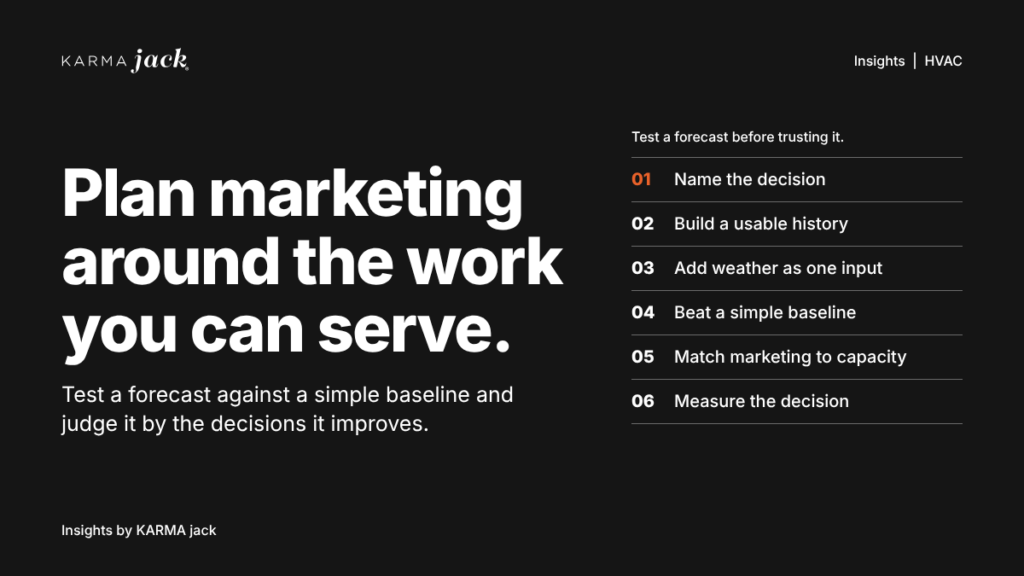
Start with the decision you need to make
Choose one practical question. How many repair appointments might next week require? Should maintenance promotion continue during a heat wave? Where is there capacity for installation estimates?
A forecast for inbound calls is different from a forecast for completed jobs. Calls reflect interest; completed jobs also depend on available technicians, parts and customer decisions.
Define the service, geography and time period before choosing a model. Then decide who can act on the result.
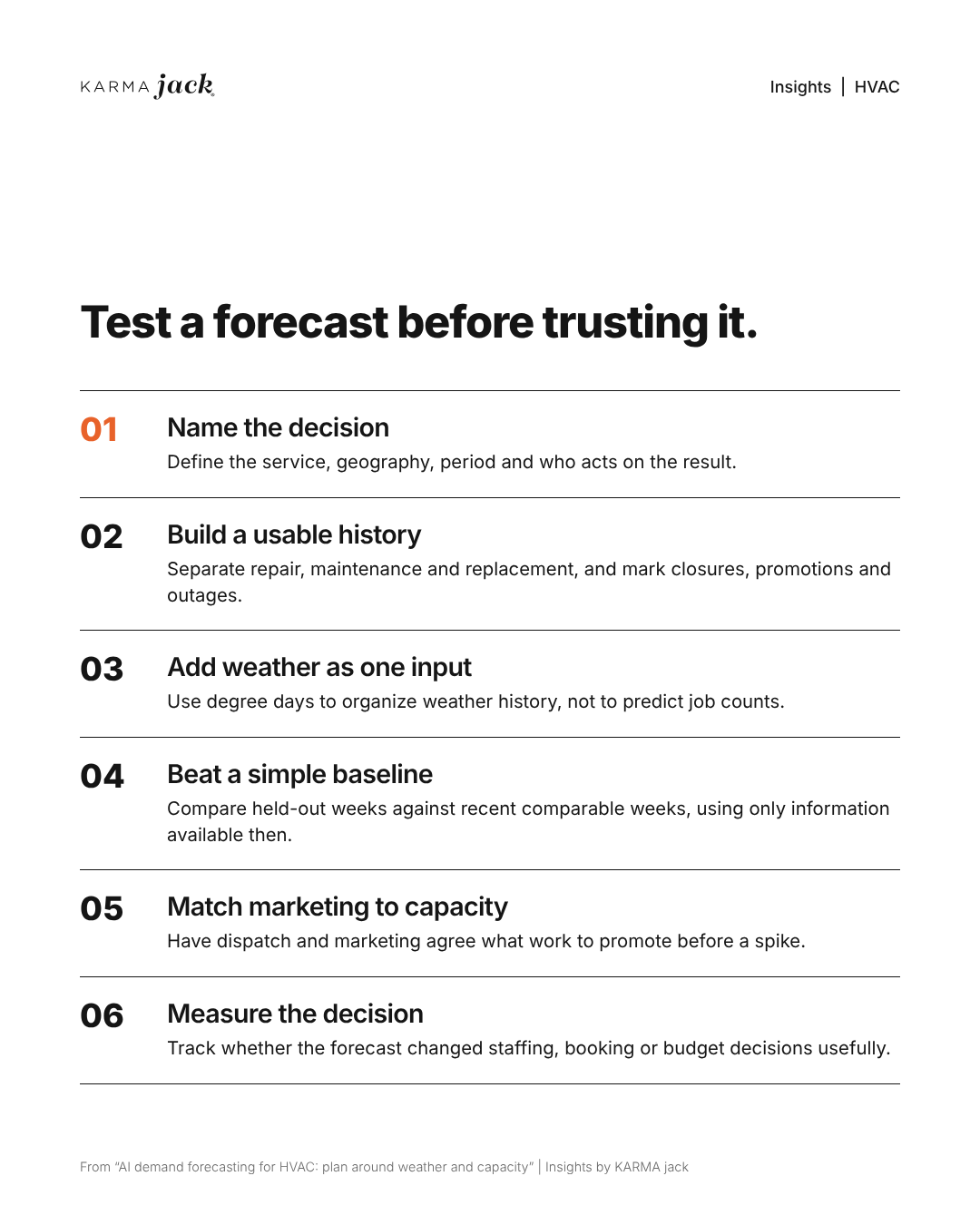
Build a usable history
Bring together job dates, service types, lead sources, marketing spend and appointment availability. Use aggregated operational records where possible and leave unnecessary customer details out of analysis tools.
Separate repair, maintenance and replacement demand. Mark holidays, business closures, major promotions and changes in service territory. If the company stopped answering calls during an outage, the record may understate demand rather than show a quiet day.
Check how the data was collected. A new phone tracking system or CRM can change reported volume even when customer demand stays similar.
Add weather as one input
Local forecasts can help your team plan for changes in heating and cooling needs. Historical weather is useful for comparing periods with different conditions.
The National Weather Service explains heating and cooling degree days as temperature-based measures used to assess heating and cooling needs. They can help organize weather history, but they do not directly predict how many repair jobs your company will receive.
Weather is only part of the picture. Equipment age, market conditions, your existing customer base and competitor activity may also affect requests. A generative AI assistant summarizing a forecast is not automatically a tested demand model.
Test against a simple baseline
Before paying for complexity, compare a proposed forecast with a basic method such as recent comparable weeks. Keep a period of historical data out of model building and use it to test predictions.
Record the difference between predicted and actual demand. Check whether errors grow during the busiest periods, when mistakes matter most.
Calculate the error before judging the model
Absolute error: The size of the difference between predicted and actual demand, regardless of direction.
In a hypothetical week, the model predicts 50 repair requests and the team receives 60. The absolute error is 10 requests: the size of the difference, regardless of direction. A simple baseline predicting 55 has an absolute error of 5, so the baseline is closer that week. These are sample numbers, not KARMA jack results.
- Run the comparison across the same held-out weeks. Average the absolute errors, then look separately at peak weeks and missed capacity. Use only information that would have been available when each forecast was made; future weather or final job counts would give the test an unfair advantage.
Keep a decision record with these fields:
- Forecast range
- Available slots
- Approved marketing action
- Person deciding
- Actual demand
- What changed
Agree in advance when capacity requires a review. A smaller error matters only if it supports a useful operating decision.
Use a range instead of a single precise-looking number. Ask what the business would do if demand lands below, near or above the estimate. If the proposed model does not improve decisions over a simple baseline, keep the simpler approach while improving the data.
Evaluate predictions as they would have been made
Use a rolling test: make a forecast using only the information available at that date, compare it with the later observed requests, then move to the next period. Preserve the historical forecast rather than replacing it with a better-looking estimate after the weather is known.
Compare the proposed model with the same simple baseline over the same periods. Report average absolute error in requests, the size of underestimates during peak weeks and how often the forecast range contained actual demand. The range should come from an explained method or past error pattern, not a decorative margin around a guess.
Check decisions as well as errors. Did the forecast cause an unnecessary budget reduction, leave useful capacity unfilled or improve the timing of a maintenance campaign? Include the cost of obtaining data and maintaining the model. A model that slightly improves accuracy but cannot change an operating decision may not justify its cost.
These are recommended evaluation steps. Local demand, staffing and marketing records are required before estimating a financial benefit. Weather data alone cannot support a promised increase in booked jobs.
Connect marketing to available capacity
Agree on operating rules before a demand spike. Marketing and dispatch should share a view of appointment availability, service priorities and the areas the team can serve.
For example, a company with a full repair schedule might stop promoting immediate appointments it cannot offer. A branch with open maintenance slots might continue a clearly scoped maintenance campaign. These are planning examples, not promises of lower advertising costs.
Keep budget changes within approved limits and have a person review recommendations. Refresh the plan when weather, staffing or parts availability changes.
Translate the forecast into a weekly operating decision
Hold a short planning review with dispatch, the service manager and marketing. Bring:
- Demand by service and area
- Technician availability
- Expected job duration
- Parts constraints
- Current campaign plan
Decide which work the team can reasonably accept before discussing additional lead volume.
Consider a hypothetical branch with 40 repair slots available and an estimated range of 35 to 55 qualified repair requests. The high end exceeds capacity by 15 requests. That is a planning risk, not proof that 15 jobs will be lost. Some callers will choose another time, some requests will be unsuitable and actual demand may differ.
Dispatch should define the honest booking message and escalation route for a full schedule. Marketing should review promises of immediate availability and decide, within approved budgets, whether to reduce repair promotion or promote another service with genuine capacity. The service manager decides whether staffing changes are practical. Record the chosen action and its trigger.
Keep existing-customer and urgent service commitments in view. Do not redirect customers to an unsuitable service simply because that campaign has available budget.
Measure the operating decision
Review forecast error alongside qualified leads, booked work, cancellations and the cost of acquiring completed jobs. Track how often the forecast caused a useful operational change.
A model can be mathematically better without making the business better. The goal is a plan your team can use before the phones get busy.
Talk with KARMA jack about aligning your HVAC marketing with the work your business is ready to handle.
Questions HVAC owners ask
Do we need years of data before starting?
You can begin with a simple planning process using the reliable data you have. Less history limits what you can infer, especially about unusual weather or new service areas.
Does AI guarantee cheaper leads?
No. Auction competition, demand, creative, targeting and capacity all affect results. Treat lower costs as a possibility to measure, not a forecast promise.
Should forecasts change ad budgets automatically?
Begin with human review and approved limits. Automate only tested, bounded changes with monitoring and a way to stop them.
What should an HVAC demand model be compared with?
Compare it with a simple method such as recent comparable weeks over the same held-out periods. Record prediction errors and peak-week misses, using only information available when each forecast would have been made.
Why separate a call forecast from a completed-job forecast?
Calls describe incoming interest. Completed jobs also depend on technicians, parts, appointment capacity and customer decisions. Define the service, geography, period and operating decision before choosing a model.
How should a forecast range be chosen?
Use an explained method or observed error pattern, then check how often actual demand falls inside the range. Review whether the forecast improves staffing or marketing decisions.

