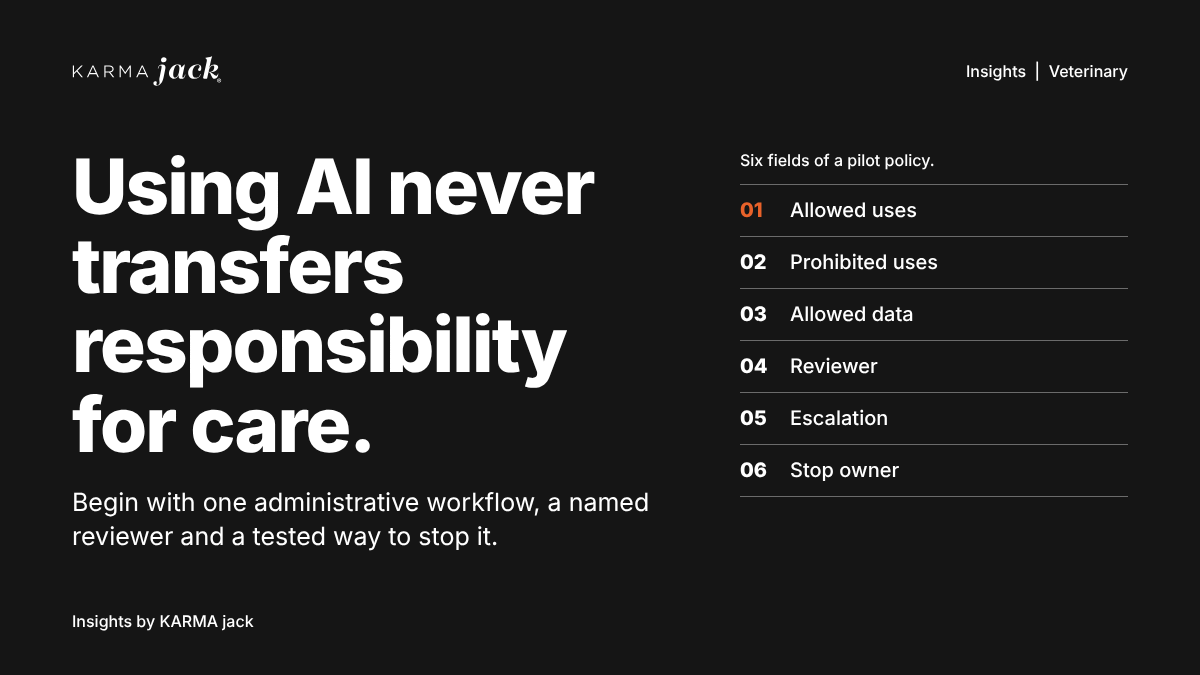
Responsible AI in veterinary practice starts with a clear policy: define what a tool may do, who checks its work and what happens when it gets something wrong.
Veterinary practices can use AI for administrative work and, with appropriate professional oversight, in clinical support. The boundary is accountability: using a tool does not transfer responsibility for care to the software.
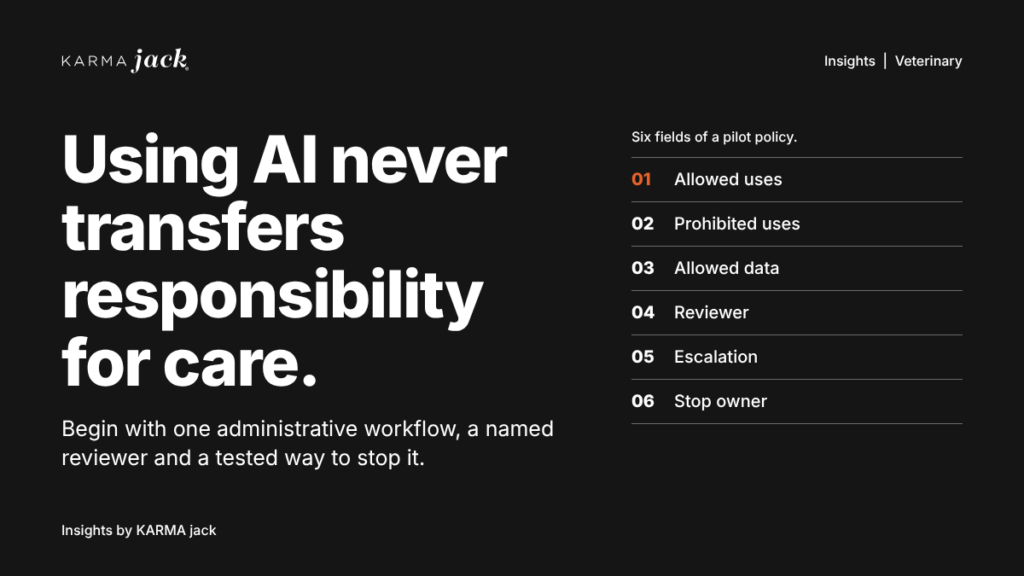
Practice owners should begin with one administrative workflow, a named reviewer and a tested way to stop the tool. The first decision is whether the system removes enough work, within the hospital’s safety and data rules, to justify keeping it. The steps below turn that decision into a supervised evaluation.
View overview graphic at full size
Start with the job, not the label
An appointment assistant, a note-drafting tool and a diagnostic-support system do different work. They need different evidence, safeguards and reviewers.
List the task you want the tool to perform. Then identify who could be affected by an error. A mistaken office-hours answer and an incorrect medication instruction carry very different consequences.
The AAVSB’s March 2025 white paper, Regulatory Considerations of the Use of Artificial Intelligence in Veterinary Medicine discusses potential uses alongside professional responsibility, transparency and data protection. It is guidance; applicable requirements depend on the jurisdiction and the use.
Build a six-field veterinary AI policy
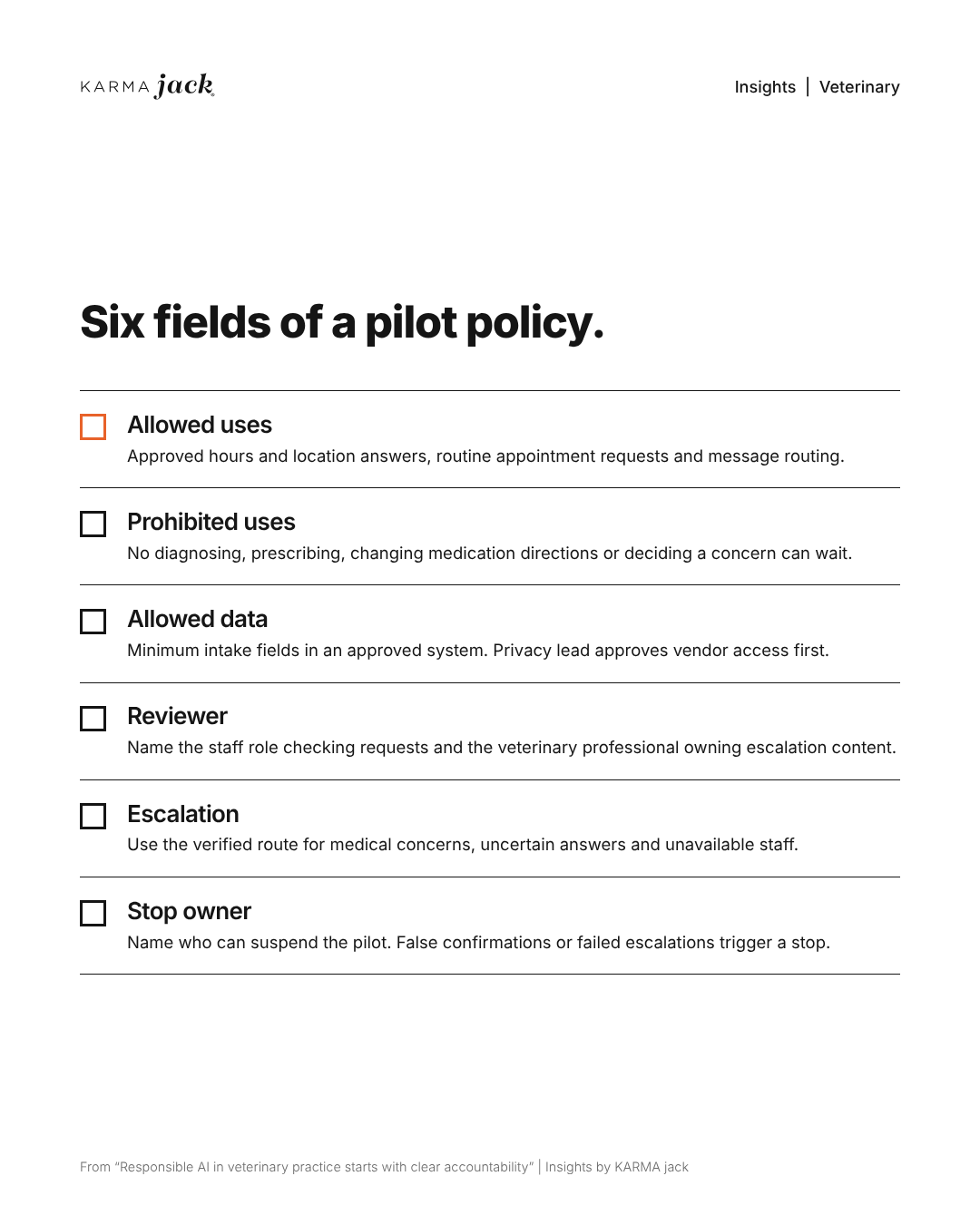
For an administrative appointment-request pilot, write down these six fields before live use:
- Allowed uses: Answer approved hours and location questions, collect routine appointment requests and route messages using practice-approved wording.
- Prohibited uses: Independently diagnose, prescribe, change medication directions, promise unavailable care or decide that a medical concern can wait.
- Allowed data: List the minimum intake fields and approved system. Exclude unnecessary records; have the responsible privacy lead approve vendor access, storage, retention and any training use before live data enters the workflow.
- Reviewer: Name the staff role that checks requests and the veterinary professional responsible for clinical escalation content. Record who covers absences.
- Escalation: Use the practice’s verified contact route for medical concerns, uncertain answers and unavailable staff. Test the after-hours route.
- Stop owner: Name the person authorized to suspend the pilot. A false confirmation, failed medical escalation or unapproved disclosure triggers a stop and review before restart.
This is an administrative planning example. It is not a completed hospital policy or legal advice. The practice must approve its own procedures against current jurisdictional requirements and the actual tool.
KARMA jack helps businesses evaluate AI strategy and operational use cases. Start a conversation about the marketing and administrative side of your practice. Clinical decisions and approvals remain with the veterinary team.
View framework graphic at full size
Give administrative tools a defined boundary
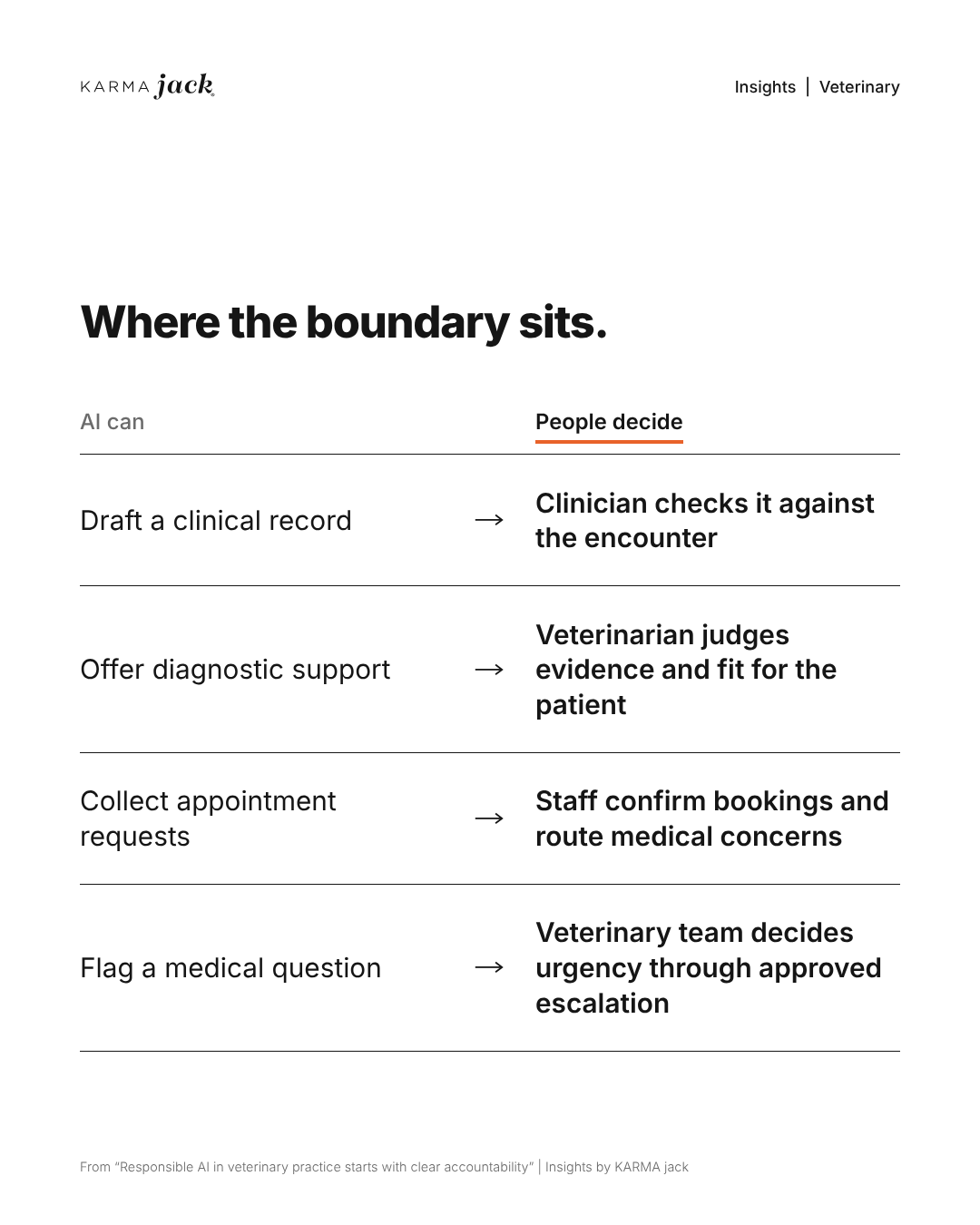
A front-office assistant may answer approved logistics questions, collect appointment requests or route a message. It should clearly distinguish a request from a confirmed booking and avoid inventing prices or availability.
For medical questions, use the hospital’s approved escalation process. A general-purpose client chatbot should not independently diagnose, prescribe or tell an owner that an urgent concern can wait.
Make the route to a person easy to understand. Test it under realistic conditions, including after hours, unclear questions and a system outage.
Can AI support clinical work in a veterinary practice?
AI already has applications in areas such as documentation and diagnostic support. Saying that it has no place in the exam room misses the distinction between assisting a professional and replacing professional judgment.
A veterinarian evaluating a clinical tool should examine evidence for its intended use, its known limitations and how its output fits the patient in front of them. The Canadian Veterinary Medical Association’s October 2023 position cautions that claimed benefits may lack sound evidence and directs practitioners to their applicable regulator.
For AI-drafted records, check the final text against the encounter before accepting it. A fluent summary can still omit information or add details that were never discussed.
View comparison graphic at full size
Ask direct questions about data and disclosure
Before using real client or patient information, ask what the vendor stores, who can access it, how long it remains and whether it is used to train models. Review deletion, export and incident-response options.
Use approved systems and the minimum information needed. A convenient public chatbot is not automatically an appropriate place for a medical record.
Tell clients about AI involvement in a way that fits the use. Have the responsible clinical and compliance leads determine consent, recording and disclosure requirements. Do not claim that a generic disclaimer settles every obligation.
Test failure before expanding success
Choose a bounded pilot and name an owner who can stop it. Use synthetic or properly approved test information to check realistic mistakes before live use.
For an administrative assistant, test a misunderstood appointment, a wrong-location request and a failed handoff. For a documentation workflow, check omissions, incorrect names and unsupported statements. Define what must pass before the tool reaches more users.
Keep a record of errors and corrections. Measure the review burden alongside time saved. If staff spend more time fixing output than the tool saves, simplify the workflow or stop using it.
Make the purchase decision from a completed test
Ask the practice manager to bring three things to a vendor demonstration: the proposed workflow, synthetic examples that reflect the hospital’s actual work, and a list of errors that would stop the pilot. Have the medical director approve the boundary before the demonstration. A sales presentation can show features; it cannot establish that the tool is safe for your hospital’s cases.
Require the vendor to show what happens when its source information is missing, a user asks for something outside scope, and the connection to the practice system fails. Ask who receives the failure alert, where the unfinished work appears and how the practice can return to its previous process. Save the tool version and configuration with the test results so a later change can trigger a retest.
For a documentation assistant, the clinician should compare the draft with the encounter for incorrect findings, missing instructions and invented statements. For a front-office tool, reception should check routing and booking status. Keep these evaluations separate: passing an appointment test provides no evidence about diagnostic performance.
How do you know if a veterinary AI tool is worth keeping?
Choose a short, supervised evaluation period and record the number of tasks attempted, accepted without correction, corrected and abandoned. Add the minutes spent checking output, resolving errors, training staff and managing the vendor. Compare total staff time with the previous process for similar tasks.
Net staff minutes saved = previous-process minutes − all minutes spent operating and reviewing the new process.
Treat this as a local measurement, not a forecast of payroll savings. Capacity released in small fragments may help staff serve clients without reducing staffing costs.
The practice manager should recommend continue, narrow or stop at the review meeting. The medical director retains authority over clinical uses. Publish only factual descriptions of the approved service: adopting AI does not establish better diagnostic accuracy, shorter waits or improved outcomes. Any such marketing claim needs evidence for the actual use.
Veterinary AI accountability FAQs
What should a veterinary AI pilot policy cover?
Document allowed uses, prohibited uses, permitted data, the reviewer, escalation routes and the person who can stop the pilot. The practice must approve these rules for the actual tool and applicable requirements.
What should a practice ask before giving an AI vendor client information?
Ask what is collected, who can access it, where it is stored, how long it is retained and whether it is used for training. Review deletion and incident procedures before approved live data enters the workflow.
When should a veterinary AI pilot pause?
Pause for a false confirmation, failed medical escalation or unapproved disclosure. Investigate and test the correction before restarting. High task volume does not offset an unsafe handoff.