A portfolio is one business to its leadership team. To a guest or prospective resident, it is a set of different places. Each location needs a clear answer: what is here, where is it, and what can I do next?
AI-assisted discovery adds another reason to get those answers right. It does not replace a usable property website. Our recommendation is to make each location a reliable destination before expanding the content calendar.
1. Give each property a useful page
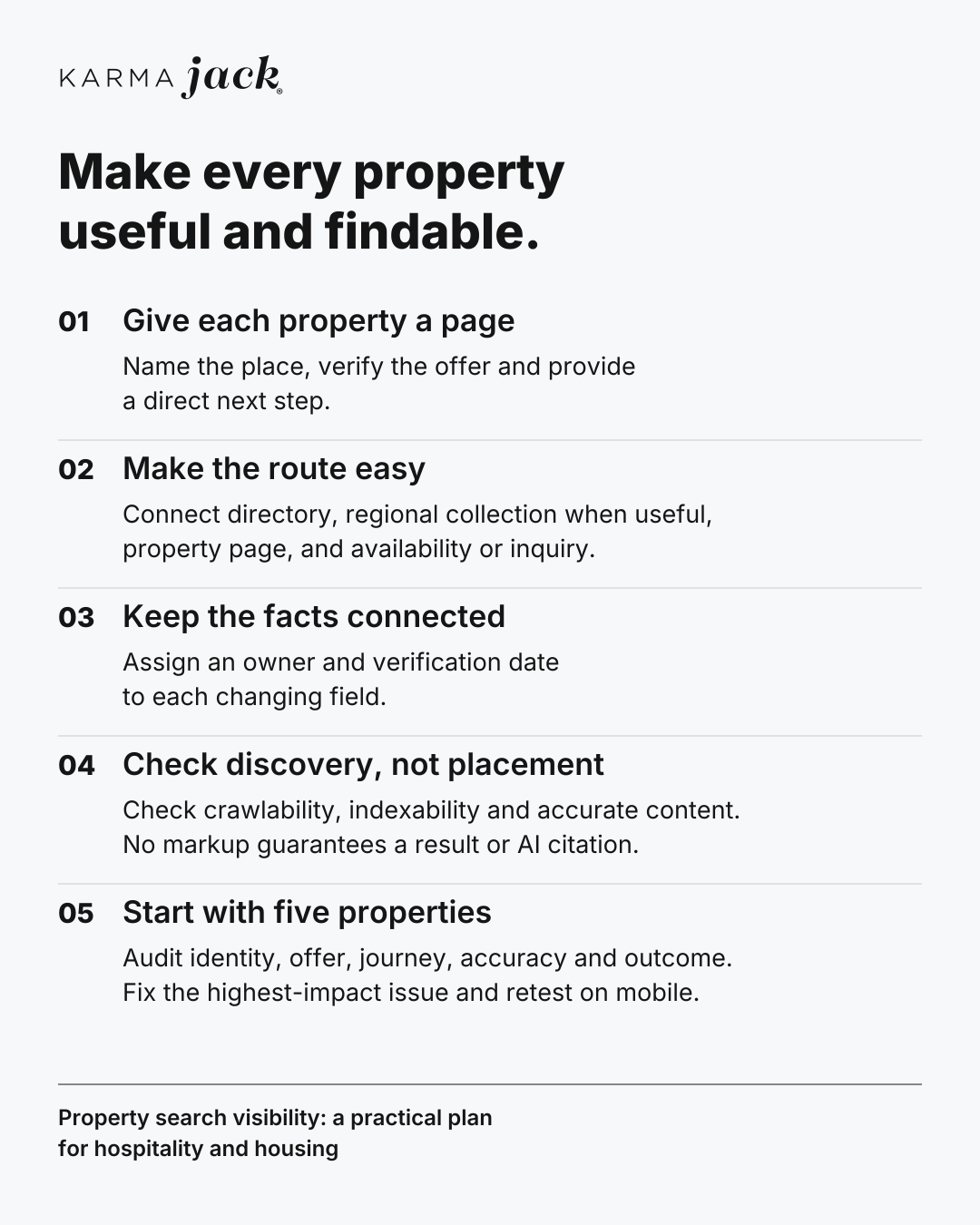
Use a stable page for each real property. Name the location, show the address, describe the actual experience and offer a direct next step. A corporate introduction alone cannot explain differences between a seasonal resort, a rental community and a home for sale.
Write the details that change a decision: accommodation or home types, verified amenities, operating seasons, contact information and how to check current availability. Use real property images. Describe accessible features specifically rather than making broad claims the team has not verified.
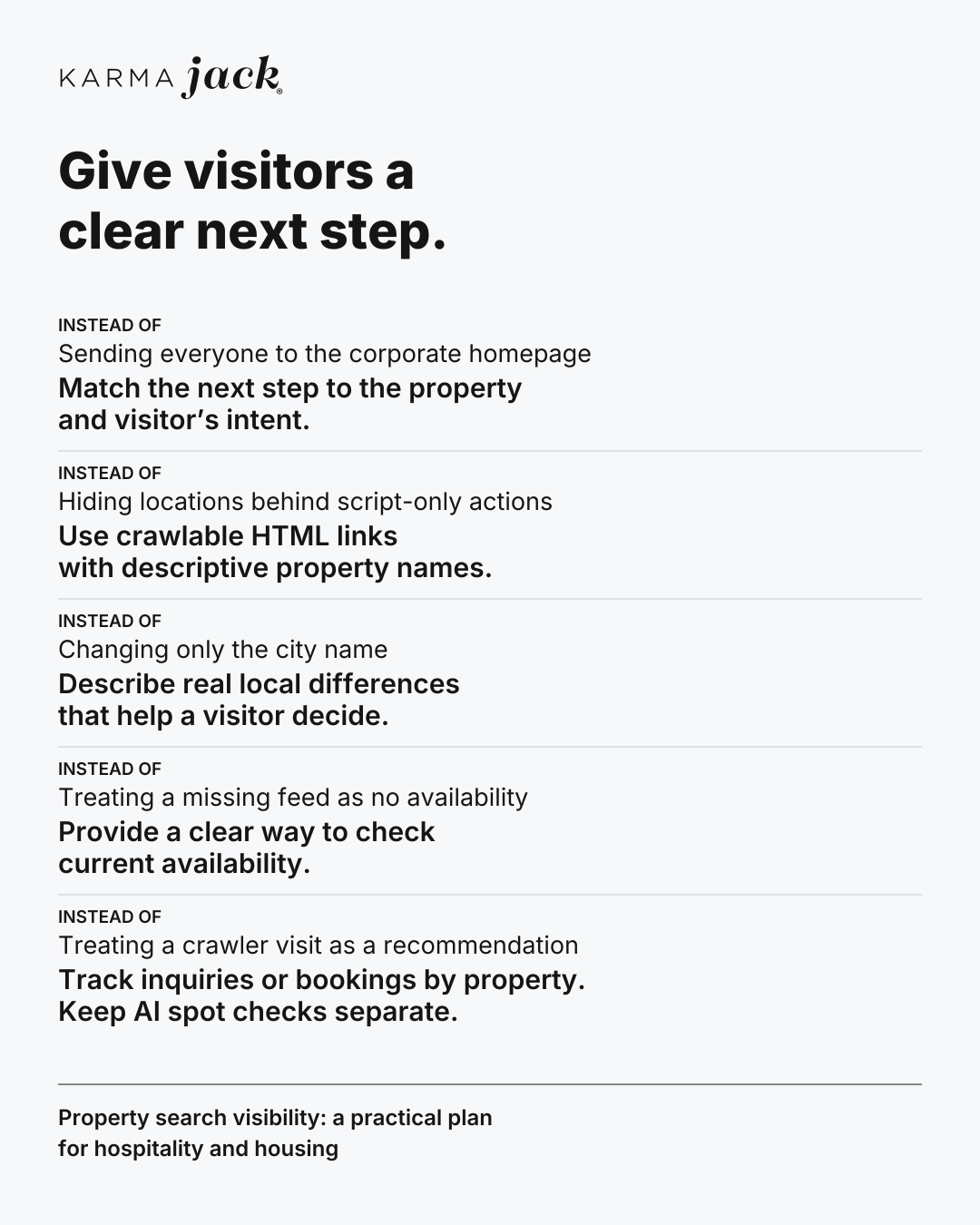
For a resort, the next step may be checking dates. For housing, it may be viewing an available home or scheduling a tour. Match the button to the location and intent. Do not send every visitor back to the corporate homepage.
2. Make the route easy to follow
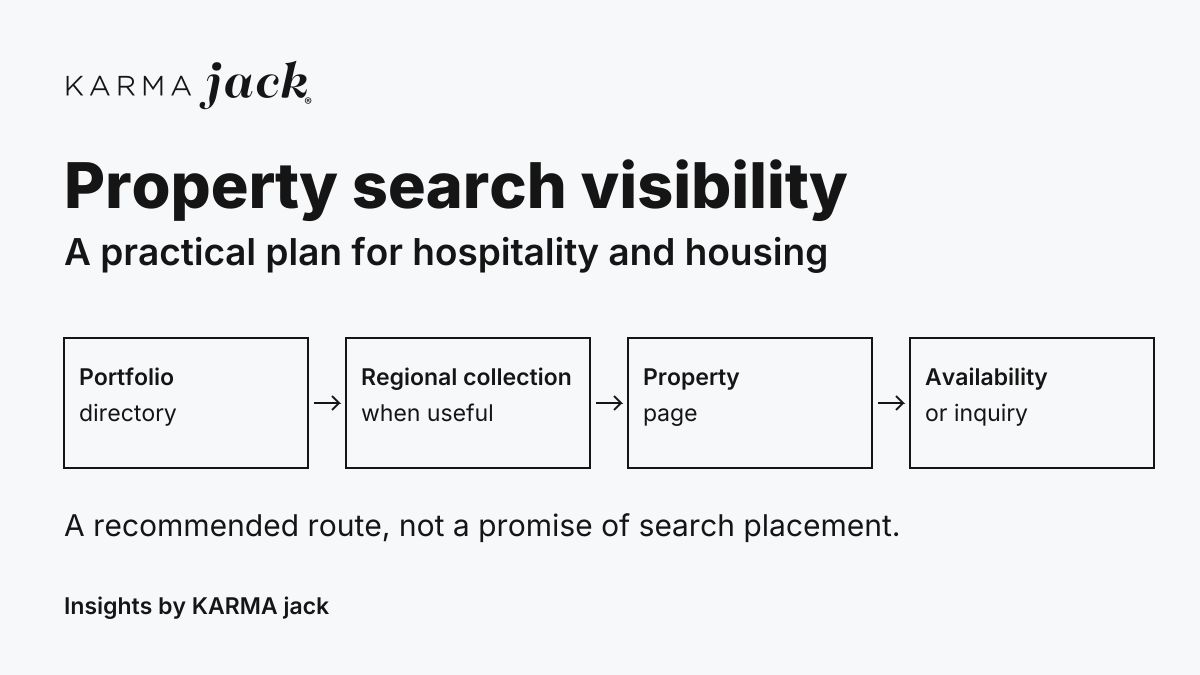
Our recommended path: portfolio directory | regional collection, when useful | property page | availability or enquiry.
Google recommends crawlable links with descriptive text. Its guidance generally calls for HTML links with an href attribute, not script-only click actions. Use the property name as the link label. Make location pages reachable without requiring a visitor to complete a search form first. [1]
Build useful local differences into the page. Replacing only the city name across dozens of pages leaves visitors with the same unanswered questions.
3. Keep the facts connected
Choose a source of truth for each changing field. Record who owns it and when it was verified. Keep the website, booking or listing system, and relevant business profiles aligned.
For hospitality, test the actual journey from the advertised offer through booking. Check the property, dates, occupancy, total price and terms. Google Hotel Center requires prices on its hotel ads and free booking links to match the booking page and disclose mandatory charges. That is a specific program requirement, not a rule for every search result. [2]
For housing, distinguish a public listing from confirmed move-in readiness. When availability is unknown, provide a clear way to check it. Do not turn a missing feed record into a claim that nothing is available.
Where LocalBusiness markup fits, Google recommends identifying each location separately and using the most specific appropriate type. Structured data should match visible content. A valid implementation does not guarantee a rich result or AI citation. [3, 4]
4. Check discovery without promising placement
For Google’s AI Overviews and AI Mode, a supporting page must be indexed and eligible for a search snippet. Google says no special AI markup is required. Access and eligibility are starting conditions, not a promise that a property will appear. [4]
OpenAI says ChatGPT search eligibility requires access for OAI-SearchBot, including through the host or content delivery network. It also states that placement is not guaranteed. A successful crawler visit is not proof of a recommendation. [5]
Have the website team inspect a small set of property pages before scaling. Check the rendered content, working links, indexability and relevant structured data. Keep confidential operational records behind access controls, not on public pages.
Start with five properties
Choose five real properties with different types and locations. Give each a one-page check record:
- Identity: property name, page URL, address or legitimate service location and owner.
- Offer: verified amenities or home types, availability route, season and total-price information where applicable.
- Journey: working directory link, mobile contact or booking action, and the destination reached.
- Accuracy: website, approved profile and booking or listing system agree on the facts that matter.
- Outcome: property-level visits, completed inquiries or bookings, reporting period and missing data.
Assign each issue to a person and retest the actual customer path after the repair.
Keep AI-answer spot checks as a separate diagnostic. Record the exact question, date, location context and cited page. OpenAI notes that search answers can be incomplete or outdated. A sample answer is not a complete view of demand or a revenue measure. [5]
The goal is practical: help people understand the right property and take the right action. Better information is work the team can control. Search placement is not.
Turn the five-property check into a repeatable routine
Have each property contact verify the offer facts and assign one central web owner to implement approved corrections. Test the most consequential customer problem first: a wrong booking destination, missing availability route or incorrect location information. Record the fix and retest the same mobile journey before expanding to more properties.
KARMA jack's hospitality and website services connect property content, search and the route to booking or inquiry. Bring the five-property check record to the planning discussion so priorities follow actual customer obstacles rather than a generic request for more pages.
Property search questions
What makes a property page useful beyond its address?
Explain the actual accommodation or home types, verified amenities, season, contact route and how to check availability. Give visitors a next step for that property rather than sending everyone to the corporate homepage.
What should a housing page say when availability is unknown?
Provide a clear way to check current availability. Do not treat a missing listing-feed record as proof that nothing is available or present a public listing as confirmed move-in readiness.
What should a five-property pilot check?
Record each property’s identity, offer, customer journey, information accuracy and measurable outcomes. Test the mobile inquiry or booking route, assign each issue and retest after the correction.
Sources
Public guidance checked October 27, 2026. The operating method above is KARMA jack’s recommendation, not a measured performance claim. Platform requirements apply to the products named and may change.
[1] Google Search Central | Link best practices
Crawlable links and descriptive link text. Supports the directory-to-property connection.
[2] Google Hotel Center | Price Accuracy Policy
Applies to hotel ads and free booking links. Supports price consistency and mandatory-charge disclosure within that program.
[3] Google Search Central | LocalBusiness structured data
Location-specific markup and appropriate types. Structured data features are not guaranteed.
[4] Google Search Central | AI features and your website
Search eligibility, visible text, internal links and matching structured data. No special AI schema requirement.
[5] OpenAI | Searching the web with ChatGPT
Crawler access, placement limits, location context and citation limitations. Does not establish a universal AI ranking formula.
Contact KARMA jack to discuss your property search strategy.